Showing posts with label art. Show all posts

Wednesday, October 20, 2010

Amazing Art & Food in Madrid


El Prado is a museum to rival the Louvre, the Uffizi in Florence, the Art Institute in Chicago and the New York Metropolitan Museum of Fine Art. We spent six hours tracing the evolving career of Goya, from a hired artist for the Royal Court, to an artist who made political statements, to a disturbed man painting his darkest nightmares after living through the horror of the War for Independence from Napoleon, and then viewing the works of Vasquez, El Greco, Ribera, Titian, Fra Angelico, Raphael, & others. Dianne "discovered" a Mona Lisa anonymous knock-off that looked every bit as good as the more famous portrait. It is clearly the same model in the same pose without the landscape background and from the same time period as Da Vinci's painting. There were surprises around ever corner.

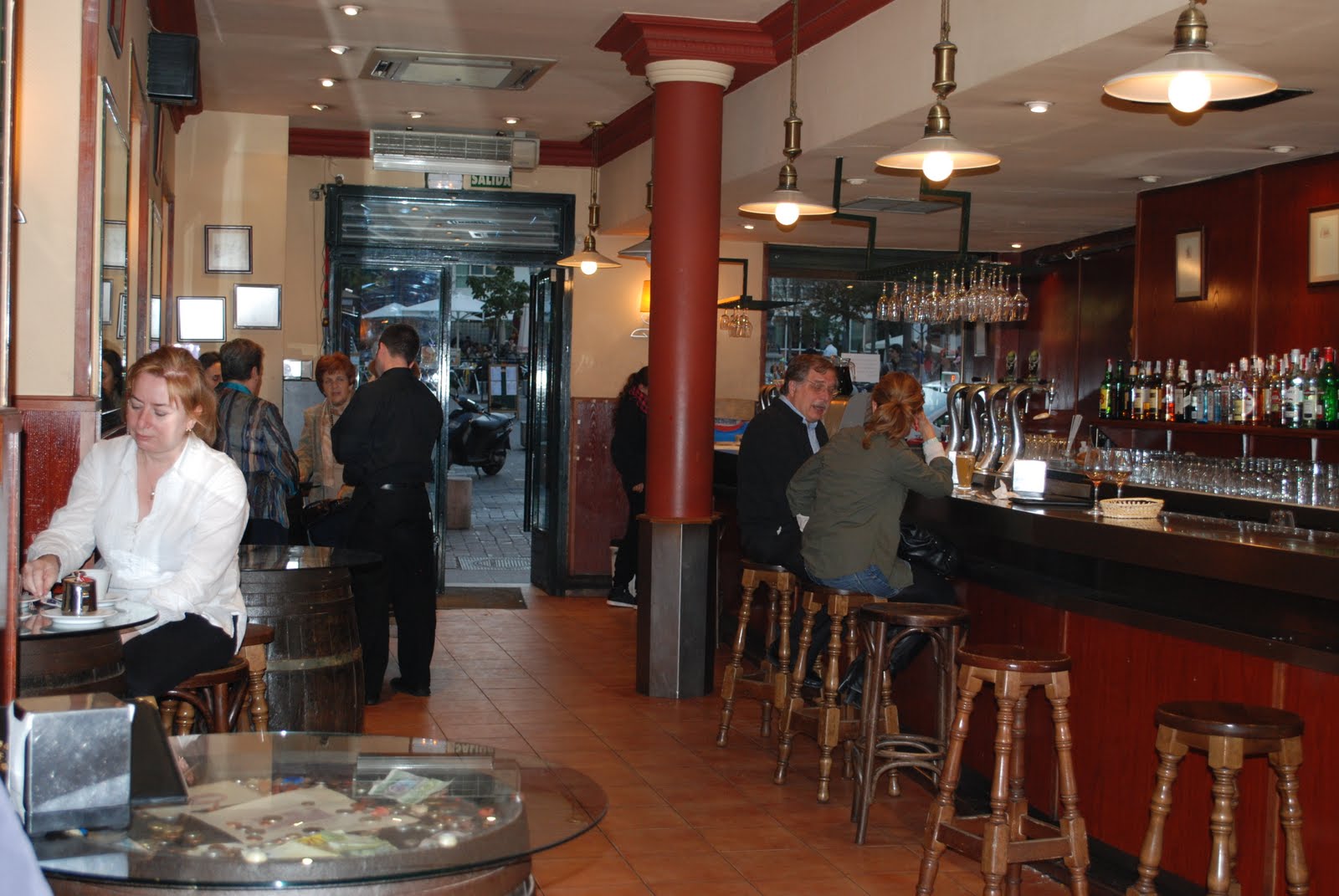
But, as amazing as the art museum was, what I really want to share with you today is about the food of Madrid. We embarked on our first "Tapas Crawl" this past evening. This is a Madrileno custom where friends travel from one pub/restaurant to another, drinking wine/beer and eating tapas (basically a Spanish appetizer). At each stop they usually get a plate or assortment to share, or just small individual servings called "pinchos." Anyway, if you are a Madrileno (that is a native to the town) and know where you are going without needing to scope the establishments out and try to size them up, and you are with a group of friends, it sounds as if it could be a fun evening. But as a couple of tourists unsure of the language, the food, and the pubs/restaurants it was actually a somewhat daunting endeavor.

The first place we stopped was a vinoteca (a wine bar) where we had a delicious Rueda Verdejo (a white wine). But, though they had a tapas menu on the table, the waiter did not return to take our order. We did not see anyone else eating in the place, so we assumed perhaps the kitchen was closed (they were advertising on the door for "help") but when we went to leave I asked the waiter if there were "no tapas" tonight and he look rather flustered as though he had missed a sale. We then checked out several more places, all of which either seemed over-priced or what I could understand of what was offered I wasn't sure I wanted to eat. We finally got off the beaten path and discovered a wonderful little neighborhood place: La Tia Cebolla Taberna (Auntie Onion's Tavern). While it appeared rather rough around the edges we dove in. The wait staff was very helpful and we enjoyed a free offering with our vino rioja (red wine) of fruti del mar (a seafood salad, which included octopus slices). This beginning was good, so we proceeded to order and then enjoyed a lovely salmon & brie on toast and the house specialty a Don Paco, which was a hot open faced sandwich of toast, tomato slices, ham, covered with melted manchego cheese, flavored with pimiento powder & basil flakes. Both were very healthy servings and were wonderful. They filled us up so our crawl basically ended there (I don't imagine a true Madrileno would end the evening after just two stops!) except for the cafe we stopped for a hotel/bar near our own hotel. I am not sure we are fans of the Tapas Crawl, but we have experienced it!

The Spanish diet is heavy on meat (much like Argentina) except that this time it is weighted toward pork rather than beef. That is very clear when you visit the Museo de Jamon (yes, that is the Museum of Ham!) This deli/restaurant is a Temple to Ham, with large leg portions of pigs hanging from the rafters and almost everything on the menu incorporating some type of pig: ham plates, ham sandwiches, chorizo sausage, etc. This is mostly a dried, salted, type of ham which is much closer to prosciutto than to our ham steaks or spiral cut hams in the US.

Overall, we have found the food very good. We had a most exquisite gourmet dinner our first evening here. We started with mushroom croquettes, followed by two cuts of veal which were wonderfully prepared, and ended with a cheesecake dessert which was basically a form of upside-down cheesecake in a bowl topped with a delicious cream and berries, along with cafe espresso para mi y cappuccino para Dianne. The owner, waiter, and chef were all very young and most attentive. It was a wonderful introduction to Spanish cooking. I fear we will not lose any weight on this vacation!

Friday, February 26, 2010

A Most Unusual Sabbath Moment


I continue to struggle, obviously, with my commitment to write every day in my journal and regularly on this blog. I still am not quite sure why. I do believe I am having trouble managing all my email and my addiction to information on Facebook and other blogs. That may be more excuse, or symptom, rather than actual issue, but that is where my thinking is moving right now.

I did have a reflection that grew out of a rather unique "sabbath" moment. I will share part of the reflection and then maybe add some more comments afterward. This is what I wrote one night back in January while I was on-call for VITAS Hospice and attending a death.

So I'm sitting in a patient's room in a nursing home, waiting for the funeral home to come and transport her body. On the wall facing her bed, in this otherwise very cold and sterile environment, is a small print of Seurat's "La Grande Jatte." It is a rather interesting painting hanging in a strange setting, so that I find it rather absurd. The painting is full of life, though somewhat surreal due to the pointillism style of design and due to the strange aura of underlying horror, sadness, uncomfortable feeling that pervades what, on the surface appears as a happy painting about people enjoying a bright day in a park. Having thought about it, perhaps it is a most appropriate print for a place where there is horror, sadness, and great discomfort being lived out every day in a facility that makes only a token effort to mask the horrible reality of people aging and dying without the presence of real love and often in great loneliness.

I always think of my son, Paul, when I see that painting. It is one of his favorite pieces of art. I called him in Salt Lake City (actually I texted him and then he called me back) to share my experience with him of seeing this print in this surreal setting. We had a very good conversation. He has clearly begun a new life for himself in Salt Lake City. His family, me included, clearly wants to still take care of him and cushion him from the harsh realities of the world. But I am growing to believe that he needs to find his own way in the world - even if it means taking some lumps along the way. I know he has a good foundation we gave to him. I know he is a smart young man and I truly believe he knows we are there for him. I trust him to himself and the arms of God and know he will be OK.

I do not often have a chance while I am working for VITAS to spend time in reflection and in jotting down some of those thoughts. Usually on a death visit I am very focused on family members present and helping them begin to cope with their grief over the loss of their loved one, as well as handle the details of calling the funeral home, dispose of the controlled medications in sent to the patient, and fill out the paper work to document the death and what I have done.

But in this case, there was no family present. Family was notified but chose not to come to the nursing home. There was no staff present, they were off handling other patients. So it was just me alone, with the dead patient, and my thoughts. It turned out to be a very positive and helpful "sabbath" time for reflection about life, death, and my relationship with my son.

What I learned out of the experience was to be alert for those moments of "mini-sabbath" opportunities that occur along the way. They are most irregular. They often come out of the blue, usually when you are not really looking for them. But they can be very powerful, both in terms of nurturing my soul, my spiritual life, but also in terms of nurturing my heart and mind. They can bring a refreshing sense of mental and emotional renewal, as well as spiritual renewal. A new step in the dance of Sabbath Tango!

The pictures are from the Art Institute in Chicago, the Seurat painting "La Grande Jatte." The larger picture is the whole piece. The closer view of the little girl in the middle begins to illustrate some of the underlying unsettling feelings in the picture.

Tuesday, October 21, 2008

Final Thoughts from Cusco


Thankfully El Balcon, the hotel where Dianne and I have stayed in Cusco, is very comfortable and quaint. Thus it was a very nice place to spend our last day in Cusco, just hanging out in the room. Dianne became quite ill last night after dinner (actually she said her stomach had been upset most of the day) resulting in a night of nausea and vomiting, with little sleep, and great discomfort. She has spent all day in bed trying to feel better, drinking a little tea and trying to slowly eat some food to keep it down. Several of the Cusco residents seem to think she is suffering from the altitude which can affect your digestive system in bad ways.

Having visited Cusco at the start of the week, seen most of the sights, and then gone on to Ollantaytambo and Machu Picchu, a day of rest was very welcome and we really don't feel we are missing all that much. We did visit two museums yesterday which had nice collections of pre-Columbian art and artifacts, including quite a few Inca pieces. They were a nice completion of our tour of Incan lands and history.

We are both ready to leave Cusco. It is a beautiful little city, very quaint and antique-looking. A lot of the architecture is still a strong mixture of Incan and Spanish colonial which is quite striking, interesting, and beautiful. The main plaza and the several little plazoletas that we visited were quite lovely. But what detracts from the beauty of the city is the poverty. We have learned from several Peruvians that work is very difficult to find in Peru. That is quite evident from what you encounter on the street as a tourist. Evidently we stand out like sore thumbs and thus are constantly accosted. You literally cannot walk half a block without being asked if you want your shoes shined, do you want to buy a painting from my portfolio, would you like some of these finger puppets, or other handcraft items, do you want some coca leaves candy, postcards, etc. Anything you can imagine they try to sell to you and it is a constant gauntlet you must pass through on the street. It is worst around the plazas, and if you dare to eat at an outside table enjoying the sun and the beautiful plaza views, they walk the sidewalk and accost you at your table! It is quite annoying. It becomes very difficult to maintain an attitude of compassion for people in such dire straits that they must resort to this type of begging to survive. And it does seem to be only a small step up from outright begging, especially by those who are very aggressive and persistent in their approach.

Beyond this atmosphere in the tourist areas, the few times we have driven beyond the main tourist areas what we have seen indicates a country in extreme poverty and extreme economic difficulty. All the housing seems very poor, even the "new" construction (still mostly of adobe bricks dug from the ground.) We have not seen any area that appears "middle" class let alone an upper class neighborhood. That may change in Lima, but in the highlands around Cusco, that is our experience. Even so, the people are lovely, (with the exceptions of the street vendors, and even the few of them we have actually dealt with in purchasing anything [I did buy a work of art for my office] turned out to be quite personable) and they seem to maintain a spirit of hope and joy in life. They offer quite a testimony to those of us, like myself, who have so much more and for whom life truly is so much easier, and yet find myself many times complaining, whining, and taking so much of my life for granted. Somehow it seems they find the joy in the very fact of being alive and find blessings to count and hope to which to cling. There is a lesson here for me in my life when I return to Miami.

Tomorrow we board a plane for Lima. We have reservations at a lovely little Bed & Breakfast in the Miraflores neighborhood, two blocks from the Pacific Ocean. We plan to mostly spend our time there, relaxing, do a little touring and shopping, but mostly rest up and prepare to return to life and work in Miami. We fly home on Saturday. Dianne returns to work on Monday and I have one more week of Sabbatical before it is over and I return to work November 1. I can hardly believe that this time has arrived.

Wednesday, September 24, 2008

Don't Wake Me From This Dream!


For some reason it hits me late at night. Each night when I turn out the lights and lie in bed waiting for sleep I realize that I am looking out the window of a ninth floor apartment in Buenos Aires, a major city in the southern hemisphere, in South America. Before I fall asleep it already feels like a dream! I walk around the streets of a city that in many respects is the most cosmopolitan city of Latin America, perhaps in the Western Hemisphere (I know I will get debate from my friends who love New York, Chicago, LA, even Miami.) But just living here is an amazing experience and I keep waiting to awaken from this dream.

Every afternoon I spend a few hours visiting a museum (yesterday I visited the Eva Peron Museum and today it was the Nacional Museum of Decorative Arts) or visiting a special park. As I walk the streets I see buildings from the 1800's and early 1900's in the French Renaissance style, the Belle Epoque style, right next to more modern high rise structures. I go out for lunch every day and go the large supermarket about twice a week. Then I visit the corner fruit and vegetable market about every 2-3 days. My lunches are casual, not rushed, my dinner's late and simple.

There is ample time for reflection, on my life, on the world, on my work life and my call to ministry. Some of that reflection comes in quiet moments spent writing in my journal. Some of that reflection comes when I am walking the streets, on my way somewhere. Some of it comes while enjoying lunch, or a late afternoon café espresso. My spiritual moments come in times of reflection, or in times of standing in wonder in the middle of a beautiful park or plaza, or while walking and reciting my Latin chant mantra: "Ubi caritas, et amor; ubi caritas, Deus ibi est." (Where there is charity and love; where there is charity, there is God.)

This has been a wonderful time of growth and reflection for me. I have grown through gaining the knowledge of how to speak Spanish and the skill to do that with some capability. I have grown through the experience of living in a different culture, a different nation, a different part of the world. I have grown through moving outside my comfort zone, pushing my boundaries, learning that I can adapt and am still fairly flexible. I have grown through the times of reflection that have allowed me to take stock of my life and my ministry. It has been and continues to be a marvelous and amazing sabbatical experience, more than I ever imagined it would be.

I have not been taking many pictures lately, and the museums here in Buenos Aires do not allow photos, even without flash, so here is a link to some photos I took in an art museum in Cordoba with a taste of Argentine artists. This link will take you to a Kodak Gallery Album: http://www.kodakgallery.com/I.jsp?c=6d2p4u6.a4avvx16&x=0&y=-ybuggz&localeid=en_US

Saturday, September 13, 2008

Adios, Bariloche!


This is my last post from San Carlos de Bariloche. It has been a wonderful place to visit and live for two weeks. My soul has been greatly nourished by the mountains and lake, even by the snow. I have seen amazing sights, I have met wonderfully gracious and enjoyable people, and I have reached the Intermediate 1 level in my Spanish studies. It was a great two weeks. In a few hours I board a Via Bariloche bus to return to Buenos Aires and life in the big city. I am much more ready for that reality now than I was six weeks ago when I stepped off that plane from Miami. I am looking forward to the experience of simply living as a local for the next 4 weeks.

As I leave Bariloche I want to share with you the Cathedral of La Nuestra Senora de Nahuel Huapi. You have already seen exterior photos of this Cathedral, because it is right in the center of the view from my apartment bedroom. But one day this past week I visited the Cathedral and it is a wonderfully peaceful, sacred space. I could truly worship there on a regular basis and find a connection with God. It is not the oldest church I have visited in Argentina, but it is one of those where I felt a strong presence of Spirit.

The Cathedral was built in 1946 and the construction is clearly more modern than the ancient cathedrals, including the use of concrete in the pillars, walls, and vault structure. But it also made heavy use of stone and it quite attractive. The name remembers the image of the Virgin which accompanied the first Jesuit missionary to the region in 1670 and they have a replica of that image, a sculpture, that graces their altar area. It is quite lovely.

Only two blocks from the Lake, the Cathedral sits on a small bluff overlooking the water. As a result, even though the lake shore drive, a very busy street, runs right alongside, it is several meters below the level of the Cathedral and the park which surrounds it, and it does not impact the serene setting. On my last day of class, walking by the park, I spotted a flock of raptors, some sort of hawk or small eagle. I never knew these birds to function in flocks, but these clearly were. It was not a huge group, maybe six birds, but still, I have always known raptors to be solo creatures, at most functioning in pairs. It was interesting and I got some great photos.

Anyway, follow the link below to the Kodak Gallery Album to enjoy the inside of the Cathedral. Someday, I hope to return to Bariloche and share it directly with Dianne. If you make a visit to Buenos Aires, I would encourage you to definitely put it on your itinerary. It is a gem spot in a country filled with amazing and beautiful places to visit.

Sunday, September 7, 2008

Amazing Views from Cerro Otto


On Friday I left the house early to walk an extra kilometer past my school (4 in total, which is about 2.5 miles) so I could ride the Teleferico to the top of Cerro Otto Meiling. (Cerro in Spanish means "hill", but this "hill" was 700 meters higher than the city of Bariloche, which is about 2,100 feet.) It offers spectacular panoramic views of the area, from the entire Lago Nahuel Huapi spread out on one side with it surrounding mountains, to the mountains even higher where ski resorts are and where tons of snow was sitting on the other. The snow on top of the "hill" was about 3-4 feet deep. There is a revolving restaurant, along with small souvenir stands, snack stands, and several places to take in the view. There is even a most unique art gallery, dedicated to Michelangelo. It houses replicas of three of his most famous statues: David, the Pieta, and Moses, in full-size replication! In a very small room in which it is most difficult to get a picture of David! It also contains about 25 pictures of other works of art by Michelangelo, such as photos of the Sistine chapel, etc. Why this art museum is housed at the top of this hill I have no idea. But it was interesting.

There are also several winter activity options at the top of the hill, such as sliding down a packed down area sort of like a luge. They rent you these little plastic sled seats that look like they were made by Tyco (I think that is the huge plastic toy manufacturer in the States) and you sit on this and slide! There were two tour buses of older teens visiting and that was their main focus.

Anyway, the views were spectacular. I spent about two hours just drinking them in. There are amazing places all over the world and whenever I visit them I continue to stand in awe of the creative power of God in fashioning this marvelous world. It is a shame more people are not able to travel and witness the amazing glory of the earth. I am totally baffled that so many of those people who hold power and who actually make the decisions that are affecting our world in terms of energy policy, conservation policy, recycling policy, etc., are people of means who do travel widely. This earth is such a treasure, such a precious jewel, and we continue to be so arrogant, or so petulant, to think that the lifestyles of 6 billion people are not affecting the climate, the ecology, the environment that is necessary not only for our own survival, but for the survival of all the other living creatures with which we share the planet. I know the earth is an amazingly resilient ecosystem, and I am convinced that until the sun explodes or dies that the earth will survive, but we may not survive and the majority of the species that have evolved to date may not survive, unless we change our practices and lifestyles.

Enough preaching, if you wish to see more of the stunning views from Cerro Otto, follow this link to the Kodak Gallery albums: http://www.kodakgallery.com/I.jsp?c=6d2p4u6.2yr3x4yy&x=0&y=7jwxdv&localeid=en_US

Saturday, August 23, 2008

Of Plazas, Architecture & Politics


The day I took the pictures of the people with their dogs I had walked down to Plaza Congresso. This is a huge plaza in front of the Congress Building. Frommer's Buenos Aires Guidebook makes the point that "this building is a good example of the self-conscious Argentine concept of taking architectural elements of the world's famous buildings and reinterpreting them. For instance, it resembles the U.S. Capitol, with a central dome spreading over the two wings holding the bicameral legislatorial chambers. In addition, the ornamental bronze roofline calls to mind Garnier's opera house and the central pediment is topped by a Quadriga or Triumph carried by four horses, the whole appearance of which directly echoes the Brandenburg Gate in Berlin." (Take a look at the pictures by following the link below.)

In front of the Congress Building in the Plaza is a HUGE fountain called the Dos Congresos. It has many levels and contains statues of people, horses, lions, condors, cherubs and other ornaments. It is quite impressive. The plaza also contains a copy of Rodin's famous statue "The Thinker," as well as a plaque dedicated to the "Virgen de Lugan, Patrona de las Rutas Nacionales," (which the way they drive here they definitely need; although it probably wouldn't be a bad idea for us in Miami, either!) and a plaque dedicated to some of those who were abducted and disappeared by the Military Dictatorship in power during the 1970s.

The same day I also saw a demonstration or protest march down Calle Callao (the school on which my school is located) headed toward the Plaza Congresso and the Congress Building. It was very large, with lots of people, many of whom had children with them. It appeared to be many working class folks, many working moms and dads, and though I could not read the banners or signs they appeared to have union symbols and some were clearly related to public education. It was all very peaceful, with some drums being used and vendors walking along trying to sell food or drink. Since I have been here I have seen this march and in some other plazas, some other smaller demonstrations. It is obvious that people are dissatisfied (there is also a lot of evidence of poverty in the city, people sleeping on the streets, even some families. There are some more pictures of this in the Plaza Congresso set of photos.) At the same time, at least they feel free to express their opinions. That has not always been the case in this country.

Follow these links to see more photos.

This link will take you to pictures of the plaza and the Congress building: http://www.kodakgallery.com/I.jsp?c=6d2p4u6.4mt9khka&x=0&y=-n6bgai&localeid=en_US

This link will take you to pictures of the march and some other street scenes: http://www.kodakgallery.com/I.jsp?c=6d2p4u6.67ai27vu&x=0&y=5ks6mi&localeid=en_US

Monday, August 18, 2008

La Boca Barrio


Today I went to La Boca barrio, one of the oldest neighborhoods in Buenos Aires. First, you may be wondering why I went there and not to school on Monday. Because today was a national holiday celebrating General Jose de San Martin, the liberator of Chile and Peru from Spain in the 1800's, which helped solidify Argentina's Independence as well. So we had no school.

Back to La Boca. I went with Rhys, a young student from Wales and England whom I met at the language school these past two weeks. He has finished his time here (5 weeks for him) and this was his last day before returning to England, and next month beginning his law studies at Cambridge. We went to La Boca to take pictures of the brightly colored buildings and enjoy the art fair and Tango dancers in the street.

La Boca is the "Little Italy" of Buenos Aires - the place where the Italian and Portuguese immigrants settled. It was the working class barrio - filled with tanneries, meat packing plants, paint factories, etc. It was because the people used the left over paint from the factories that their houses became such a bright collage of color. La Boca was also the birthplace of Tango and of course is the home of the famous La Boca Juniors futbol club - the club that produced the great Diego Maradona. The community definitely has spirit for their soccer team, wherever you go you see "oro y azul" (gold and blue) (the team colors) as well as many shops that sell La Boca Juniors memorabilia.

La Boca is still a very rough neighborhood. At least according to the rumors, stories, and guidebooks. They tell tourists not to wander away from the tourist area and suggest you should not bring expensive cameras into the area (but it is such an interesting place that I had to take out my camera). They also say the police only patrol the tourist area during the daylight and then leave at sundown. It seemed safe enough to me, but we did follow the stories and took a taxi in and out of the tourist area, instead of trying to walk in from outside and passing through the regular neighborhood of La Boca. If you want to see pictures of the barrio or of the Tango dancers, follow these links to the Kodak Gallery Albums I created. This link goes to pictures of the neighborhood: http://www.kodakgallery.com/I.jsp?c=6d2p4u6.ciq7wl0a&x=0&y=m7jvcc&localeid=en_US

This link takes you to pictures of Tango dancers in the street: http://www.kodakgallery.com/I.jsp?c=6d2p4u6.470in80q&x=0&y=-7pah57&localeid=en_US

Sunday, August 17, 2008

San Telmo and Puerto Madero


I went to San Telmo and Puerto Madero, two new barrios (neighborhoods) for me. San Telmo is one of the oldest barrios and Puerto Madero is one of the newer. San Telmo was the home of the very wealthy until the 1877 outbreak of yellow fever caused many to flee to newly developing areas north of the city center. This is also the area where Tango developed (and the area where the Bush twins were robbed). On Sunday the heart of the area, Plaza Dorrego, is taken over by an Antiques Fair, which actually spreads down Calle Defensa with street musicians, puppet masters, magicians, clowns twisting balloon animals, and more. It was a wonderful atmosphere and there was also some fascinating architecture, wrought-iron balconies, and murals on street walls. It was a wonderful place to visit.

Plus, I had a really delicious lunch. I ate at Bar El Federal, which is one of the barres notable, which is an historical designation tagged on a number of the bars that are around. This bar was constructed in 1864 and has a marvelous atmosphere with very old wood trim, and other decorative items that lead you to feel you have stepped back in time at least 60 years. I had a pollo sandwich Federal (which was a large chicken breast, cheese, lettuce, tomato, onions, grilled red pepper, bacon, and a fried egg! all on a french baguette.) It was huge! But I ate it all (and then walked off all those calories the rest of the afternoon.) An interesting thing occurred at lunch. There was a painting on the wall of the bar of a man and I recognized it at Carlos Gardel, one of the most famous, old time Tango singers. The joy of the moment was to realize that I have been here long enough and become immersed in the culture to the point where I could recognize his picture without reading a label.

After enjoying the street fair in San Telmo, I walked over to Puerto Madero. This is the newest barrio in Buenos Aires. In fact, it is still under construction. This is the Miami Beach of Buenos Aires! It was once a dilapidated port, the area is now filled with an abundance of restaurants (very high priced) in renovated warehouses. New construction is also going on building high-rise office and apartment buildings. Besides the very modern construction, the major highlight of the area is the Bridge of Woman, a pedestrian walkway across one of the port canals. It was designed by Santiago Calatrava, who is said to have designed it after the silhouettes of Tango dancers. It is a stunning piece of engineering and design.

It was a most enjoyable day. Wherever I walked I saw many, many portenos out walking with family and loved ones, especially many families out with their children, enjoying the warmer weather, the sunshine, the sights, and the chance to be relaxed and out enjoying the day with the ones they loved. If you want to check out more pictures of San Telmo and Puerto Madero, here are the links you may use to go to the Kodak Gallery albums I have created. Use this link to reach pictures of San Telmo: http://www.kodakgallery.com/I.jsp?c=6d2p4u6.529ot3oa&x=0&y=m543xa&localeid=en_US

Thursday, August 7, 2008

Cementario de la Recoleta


On Tuesday of this week we had our consultation with the Tour/Activities Director provided by the school. He was mas o meno helpful (that means so-so). So, that afternoon I took off on my own and went to visit Recoleta Cemetery. It is a very old cemetery in one of the more upscale barrios of Buenos Aires. It is like a small "city of the dead" because it is all mausoleums. So you are walking down pathways between mini-buildings. It feels like you are walking in a mini-city. The mausoleums are quite interesting, with many quite stunning. There are many famous people in Buenos Aires and Argentine history buried here, including Eva Duarte Person, the famous "Evita". Her grave is still the most visited and there are flowers left on the door by admiring patrons. In the pictures you will see a shot of the people gathered at her tomb. I did not experience this at any other tomb in the cemetery and there were quite a few people wandering around. The guidebook says that eventually, to prevent the various generals and political people from stealing her body, they had to bury it 27 feet down in concrete! There are also many former presidents of Argentine buried here, along with various senators and generals, etc. Also buried here is Jose C. Paz, the founder of the famous paper "La Prensa." He was one of the wealthiest men in Buenos Aires once, and built the grandest house in town. So, as you will see in the pictures, his family tomb had to be grand as well. It is not the largest, but one of the most beautiful, with polished black granite walls and stunningly white marble angels sculpted from the same Italian marble which Michelangelo used. There are also some fascinating juxtapositions of symbols in the cemetery, interesting use of statues to create dioramas of mourning, and in intriguing use of Egyptian symbols as well. Enjoy the pictures by using the following links to the Kodak Gallery Albums I have posted.

This link will take you to an album with general pictures of the cemetery:
http://www.kodakgallery.com/I.jsp?c=6d2p4u6.8zvk1qi2&x=0&y=-jr9tt3&localeid=en_US
This link will take you to the album with pictures of Eva Peron's grave:


This link will take you to the album with my pictorial study of some of the Angels of Recoleta: