Friday, September 2, 2022

Life in the Wilderness a Practice of Mindfulness


Life in the wilderness is a marvelous exercise in mindfulness: the spiritual practice of purposely bringing one’s attention to the present-moment experience without evaluation. To my way of thinking, the more mindful one can become, the more existentially one can live life, focused on the moment, the here and now, rather than worrying over the past or fretting about the future. 


The wilderness is a wonderful lab for practicing mindfulness! First, as I mentioned in my last post, life in the wilderness focuses you intensely on the basics: providing shelter, food, security. One of your first tasks in the Boundary Waters Wilderness is to find a campsite. You do not have to thrash about to do this. You must camp on designated campsites. This minimizes the impact of human presence and activity on the wilderness. A designated site has a fire grate and a latrine box. They are clearly marked on the maps, though you might have to search a little to identify some of them.


Once at a site your focus becomes setting up camp, which is securing shelter. This involves unloading all your gear from the canoe. Identifying the most comfortable tent pad (a relatively flat area with as few roots and rocks as possible on which to place your tent); set up the tent. Then it is best to hang a rain fly to protect your gear from the elements. Finally, you must hang a rope assembly with a pully, from two trees. This is where you will hang your food pack to protect it overnight from bears and other critters desiring to share in your good smelling provisions. This is easier to describe than it usually is to execute. Some trips I have spent hours attempting to get the two ropes up over limbs of trees high enough to have the pack hang 10 feet off the ground and at least 10 feet from any other tree. This trip we completed the task in relatively short order.


Once camp is established, you have taken care of shelter and security. The other basic need is food. In the wilderness this involves cooking over a wood fire (which means you need to gather some firewood, preferably dry branches up to an inch in diameter) or cooking over a propane stove. We enjoyed steaks the first night in camp, so we cooked over a fire, but all the other nights we cooked over propane. It is easier, faster, and you don’t have to protect your pots and pans from soot by coating them with Fels-Naptha soap. (We also did not have any of that soap, as the Outfitter forget to provide it in our supplies!) It is also easier to cook over propane as most of the food is freeze dried and primarily involves boiling water. Not a lot of need for that smoky, woodsy flavor that comes from open fire grilling!


The second way life in the wilderness helps in the practice of mindfulness is by providing an abundance of life to observe all around you! From the beautiful vistas of the lakes, sky, clouds and weather on the macro level to the micro level of butterflies, moths, dragonflies, mushrooms, mosses, and all manners of plant life. Add in the larger birds and waterfowl, and other mammals, and there is just so much to observe. I will write more about this in my next post, but if one is not paying attention to all the life around you then you are missing an amazing smorgasbord of wonder and beauty.


Finally, the wilderness assists you with the practice of mindfulness because there are far fewer distractions than we normally surround ourselves with in our daily life. In the wilderness you do not have electricity (other than battery power); that means you don’t have TV, computers, Cell phones; no phone calls can reach you there. (I will admit this trip we discovered that we were still on the grid where we camped. Testament to improved cellular service, most likely influenced by the demand of the Outfitter to be connected to the wider world for their business needs, and to the fact that we were not very far into the BWCA. We did explore a couple lakes and rivers further north of our campsite one day and discovered that we quickly lost all cellular service, so most of the wilderness is still off the grid.) I did take my journal and my camera but writing in my journal and taking photographs help me be more fully present in the moment.


Saturday, August 27, 2022

A Return to the Wilderness


 For four days in August of this year I returned to my slice of heaven on earth: the Boundary Waters Canoe Area Wilderness. This was my 9th trip in 40 years. Five of those trips have been made from my homes in Miami, Florida and Savannah, Georgia, thus requiring a full two days of travel to get there and to return home. Clearly the lakes and rivers, spruce, pine and birch trees of the Northwoods of Minnesota have a strong pull on me. 

This pull even overrides the strong physical test and toll that it takes on my body each trip I make. This is a designated Wilderness Area, which means no motorized transportation is allowed. The only way to enter is by canoe or on foot. You must transport all your equipment and food for your time in the wilderness by canoe or backpack. This involves paddling fully loaded canoes up and across lakes, sometimes battling strong headwinds, portaging your canoes and equipment on rocky trails or across beaver dams to access rivers and streams that connect the lakes. All in search of a campsite where you then must unload all your gear, set-up your tent, rain tarp, hang your bear ropes to hang your food pack at night, and then see to your meals! It returns life to the basics, securing food, shelter, security. 

But this is all done while you are surrounded by the most beautiful, glorious canvas of blues and greens, browns and whites. With fluffy clouds scudding across the deep blue sky on sunny days and ominous, low hanging gray clouds when overcast. The weather is constantly changing and often in dramatic ways. The water is crystal clear and, though the outfitters and National Forest Service warn you to sterilize your water before consuming it, (and there is risk of bacterial infection) still you can drink it if you do so far enough from shore and it tastes cold and pure and better than any tap water! 

So, while visiting the wilderness is challenging and hard on me physically, it is just the opposite for me emotionally and spiritually. The wilderness is renewing and freeing and relaxing. My mind and my heart and my spirit breathe more deeply and freely in the wilderness. That is why I have returned again and again, now for 9 times. 

It is also a place where I have always been able to journal, faithfully and prolifically. In the wilderness I am able to write freely and deeply, exploring life and my inner self. What else is there to do here, beyond meeting your basic needs for living? I easily find the time, focus, and energy for writing. In the Northwoods, off the technology grid, it is just me, and the loons, birds, fish, mosquitoes, flies, trees, lakes, and my own thoughts. It is a perfect setting for reflection, meditation, contemplation, and writing.

So, with this introduction, you have probably surmised I am hoping to revive this blog: Sabbath Tango. I have many more thoughts to share which I will be posting (be patient with me as I am now back home and no longer in the wilderness and daily life intrudes much more on this activity of writing and sharing) in the days to come.


Wednesday, August 19, 2020

The intimacy of the air we breathe


I was raised in a Christian home. I was also raised to value education and I received a good education in the public schools of St. Louis, MO. My parents valued that education, until they gravitated back to a more biblically literal approach to their faith.  Then they questioned whether they had provided me and my siblings the proper education or had corrupted us with one too secular.


But I have always appreciated my education, especially my exposure to and training in the sciences. My love for science was midwifed in me by my 5th grade teacher who shared with us her own love for science and experimentation. That love was nurtured all through High School and into my early years of college. I was a good student in my science classes and I was on a track to become a scientist; until I felt a call to become a minister.


While my education in the sciences ceased at that point, my love and appreciation for science never waned. I never felt a dichotomy or adversarial relationship between my faith-based approach to life and the scientific explanations for life. Science explained the world and life. Religious faith provided meaning and purpose to the world and life. They were complementary views and understandings, not contradictory or competing systems of meaning.


All of which is preface to the statement that I am befuddled by the current antagonism toward science in our nation! Johannes Kepler, a 17th century mathematician and astronomer once wrote about his own work: “I was merely thinking God’s thoughts after him.” And Albert Einstein said: “All religions, arts and sciences are branches of the same tree.”


Both Religion and Science seek to provide a cosmology: an understanding of the origin of life in the universe. For religion that cosmology is informed by creation stories and holy writings. For Science it is informed by scientific observation and tested theories. Whether that story is about a Big Bang, or God speaking creation into being out of nothing, or thinking creation into being, or bringing creation into being out of some cosmic battle or struggle, all the stories are trying to offer an understanding of the beginning of the universe as well as teach us something about current life and reality.


What current scientific understanding teaches us about origins and life today through the theories of the Big Bang and Evolution is that everything in the universe – and I do mean EVERY. SINGLE. THING. – is intimately connected.


Canadian blogger, Jim Taylor, once shared a reflection inspired by watching the bubbles in his glass of Guinness separate into foam and dark beer. He recalled how one cosmologist, Angela Tilby, in her book Science and the Soul, poetically described the evolutionary process of the Universe as “spacetime foam”. Out of the explosive beginning, as that foam of energy particles expanded it began creating space and time. Eventually the foam began settling into its components.  Sub-atomic particles coalesced into atoms, into molecules. Gravity began pulling molecules together. Crushed closely, they generated heat; compressed, they began fusing into more complex molecules. The fusion created more heat. In the fullness of time, it blew some of those new starts apart and blasted heavier molecules out into space.


Gravity clumped some of those heavier molecules together, and formed rocky planets, like ours. On these planets some complex carbon-based molecules continued fusing.  But instead of creating heat, they created life – plants – which exhaled oxygen as a waste product. The oxygen levels of this planet increased from zero to around 20 per cent. New forms of life emerged from the seething stew to make use of this un-utilized raw material – animals – us.


 Everything that exists today derives from that original “foam.” Everything, alive or dead; everything that was, or is, or will be – we are all related by our common origins. But not just by our origins. Jim Taylor also shared how Bob Sandford, chair of the United Nation’s Water for Life Decade, started one of his speeches by saying, “Every time you take a breath, you inhale the exhalation of every living thing on this planet since the beginning of life.”


We are all intimately related. By our breath, by the elements that make up our bodies, and by the fact that every molecule, every atom, can trace its origins back to that original foam.


But now, in the age of COVID, by our breath is the key learning here. When we breathe we are breathing in common air. You don’t have your own private bubble of air, nor do I. It is the same air which has existed on this planet since the dawn of plant life which began exhaling oxygen until it gave life to us. The oxygen on this planet – the air we breathe – is a shared resource. It gives us all life. It also can carry illness and death. Let us use the resource wisely and share as we were taught to do in Pre-school and Kindergarten.  And the way to wisely share is by wearing a mask when I am close to you and intimately sharing that air with you.


Thursday, August 16, 2018

Look Up!


I have walked our 2 dogs, Molly & Ivy, past this large oak tree on the corner of our block dozens of times since we have moved here just over a month ago. It just seemed an ordinary oak tree with a large, unremarkable trunk.  But this morning when I was walking the dogs, they paused for an unusually long time at the base of that oak, sniffing all around as they do.  While standing there this time my eyes traveled up the trunk of the oak to an amazing sight!  The branches of the oak were covered in small ferns and other lush green plant growth.  All of it was clearly not part of the oak tree, but rather was evidence of a living, thriving plant community that had taken up residence on that tree.  There seemed to be an entire ecosystem in the branches of that oak tree.  But I had never noticed it before because I had never looked up!  I had never lifted my gaze from the ground to take in what was around me on a higher level.


How often do we go through our days with our gaze focused on the ground!?  For the past two months that has been where my gaze has been directed.  It has been locked on the ground in front of me as I have been totally task-oriented and focused.  For the past two months I have been consumed with the tasks of closing down our life in Miami and restarting our life in Savannah.  It was not an easy move. 


While our move was complicated by the onset of health issues and unexpected knee surgery for my spouse, I suspect that no move in our modern, hi-tech society is easy.  There are just so many tasks involved in relocating a life: from closing down accounts (and in some cases returning equipment), notifying all sorts of people and businesses of address changes, boxing up your life (and in the process sorting through all your possessions to decide what needs to be moved, what can be sold, what should be given away, and what needs to be trashed) scheduling the move (including assistance with loading the truck), scheduling the start-up of utilities and services in the new location, actually moving all your possessions and then the process of unloading the truck and unpacking the boxes. 


Of course, this is just a microcosm of most of our lives in general. For me I can point to any number of rationalizations for what has been transpiring in my personal and work life for the last number of years that have kept me focused on accomplishing the task in front of me and when it was done moving right on to the next task presenting itself.  This is often praised as good concentration; being focused; responsible; strong work-ethic.  But in the process we miss so much.


With my gaze focused on the immediate task, on the ground in front of me, I miss the hidden ecosystem thriving above my head.  I miss the faces of the people I pass on the street.  I miss the beautiful blue sky above, and the cotton ball clouds gently floating along.  I miss the opportunities to pet the dogs, to play with grandchildren, to gaze with love in my wife’s eyes.  I miss the possibility of engaging in relaxed conversation with dear friends and sharing memories and stories with extended family.  I miss the chance to relish and treasure the places which make the place I live special and then wonder when I leave why I never visited that place or did that thing.


There is so much more to life than attending to tasks and responsibilities.  While many of those things are necessary and need attention, if that is all we pay attention to, we will miss so much of the beauty, wonder, and special moments of life which truly lift it and make it unique and worthwhile.  One of the gifts of retirement is unfettered time.  I want to make sure it does not become frittered time and one way to do that is to be sure to LOOK UP more.  It is also the gift of Sabbath time, which God offers us once each seven days and encourages us to find even more opportunities to embrace.


Taking time to LOOK UP is one action which might lead to more Sabbath moments.


Tuesday, August 14, 2018

A New Beginning


Five years!  I cannot believe it!  It has been FIVE YEARS since I last posted in this space.  Sabbath Tango went dormant for five years, and oh, so much has happened!  There has definitely been a lot of Tango (more figuratively than literally) during that time and there has been, sadly, very little Sabbath (at least in the sense of true rest, time with God, time to soak in creation and enjoy the life God bestowed upon me.)  So much has happened and, while my inclination is to try to bring you up to speed all at once, I realize that would not be in the spirit of this blog, so let me just say that I am beginning anew.


I am renewing Sabbath Tango, and I believe that the original intent of this space will still be honored by my new postings.  Originally I created this blog to document and reflect upon my Sabbatical in 2008.  The majority of that time was spent in Argentina, learning the Spanish language and the culture of Buenos Aries.  Thus the name: Sabbath, a time of rest, reflection and renewal & Tango, the national dance of Argentina.  But more than that: the title expressed a belief that all of life is composed of a rhythm between pause and action – just like the Tango, which has deliberate movement, highlighted by flurries of activity and punctuated by pauses in all of it.


As I already hinted, my life has changed dramatically recently.  I am not on a new Sabbatical.  Rather, I have retired from my position as local church pastor.  After serving 5 different congregations in five different communities for the past 40 years, the last one for 24 of those years, it was time for me to take an extended “sabbatical” from local church work.  I have done just that and in the posts to come I will share reflections on that experience of saying good-by to a local church and to local church ministry.  I will also continue to post reflections on my new life and on what unfolds as the Spirit guides me into new activity.


I invite you to follow along and pray my reflections may prompt reflections of your own.


Monday, July 1, 2013

Exercising My "Wonder" Muscles


The world has enough “Shock & Awe” campaigns.  What is needs more of is “Shock & Wonder.”  So began Quinn Caldwell, United Church of Christ pastor and one of the two resident theologians at General Synod 29 in Long Beach, California this weekend.  He and Rita Nakashima Brock have the task of leading us in reflecting theologically about our time together as a Church in this national gathering.  At the end of each plenary session they take some time to help us think about God – in the midst of all the other talking, thinking, debating, listening, and discussing.

Their first theological reflection on Saturday morning was about the capacity for WONDER!  Quinn reminded us of the difference between wonder with a small “w” and Wonder with a capital “W.”  Small “w” wonder is: “I wonder why she chose that outfit?”  “I wonder when the pastor will finish this sermon?”  “I wonder what will be on the breakfast buffet?”  Capital “W” Wonder is: “Wow!  The Grand Canyon!”  “What a beautiful new baby she is!”  “What an amazing world we live in!”

To cultivate our capital “W” Wonder we need to practice more of the small “w” wonder, but in a kind, gentle, caring, compassionate and curious manner.  He encouraged us to not approach life thinking we have it all figured out.  Especially don’t approach other people thinking we have them all figured out, but instead “wonder” about them – what fire of hope burns in their chest?  Where have they been in life?  What have they had to deal with?  What has been their journey which brought them to this moment?

Wonder requires the ability to be surprised.  Life is so much more than our small existence … the way of wonder is to cultivate curiosity.

In Long Beach this week I have been very good about waking up at 6:00 a.m. and taking an hour walk.  Each walk has been filled with moments of wonder.  The first day I walked from our hotel past the Convention Center to Rainbow Harbor, around the harbor to the light house on a small hill overlooking a point in the harbor, back around to the marina.  It was a very foggy early morning with the shore and water under what they call a “marine layer” of clouds.  (To me it looked like fog.)  I watched the fishing charter boats leave loaded with hopeful people eager to catch fish.  I watched the street people waking up from their scattered sleeping spots on the lawn, on benches, tucked into doorways. (Long Beach has 4,290 homeless people living on the streets, beach, and in the parks.)  I wondered what brought them to this station in life?  I wondered how many of them were here by some choice of their own and how many were here by forces beyond their control?  I wondered how many of them have given up hope and how many have embraced life and are making the best of what they encounter every day?

Then as I was about to leave the harbor area and head back toward the hotel I heard a barking sound.  I have not heard them for a long time, but I recognized the bark of a seal.  I searched the water and the docks in the marina and sure enough, there it was – a large seal sitting on a dock next to a small boat.  Suddenly my morning of small “w” wonder turned into a moment of capital “W” Wonder.  Thank you, God, for this gift.

On other mornings I have walked the beach at Long Beach (and it is a “looong” beach!)  I have experienced other moments of both small “w” wonder and capital “W” Wonder: Why are there bluffs overlooking the beach here in California?  We don’t have anything like that in Florida and yet we both have sandy beaches at the shoreline.  Where are the sea shells on the beach?  There don’t seem to be any, only sea weed.  The first morning walking the beach I came upon a glorious, beautiful mural painted across some concrete structure set back into the bluff.  (It is pictured above.)  Another morning I walked all the way to Belmont Pier only to find the pier locked, but on the east side of the pier there was a Pirate encampment for the weekend Pirate Festival.  What a nice surprise!


 There is so much to wonder about and to wonder at in the world and in life.  Travel and Sabbath times certainly help to keep the wonder alive.  But I need to remember to keep exercising my wondering ability and my curiosity each day of life.  South Florida is certainly filled with “wonder-ful” experiences and moments.  All of life is “wonder-ful” and I need to remember to keep “wondering” so I am ready to “Wonder” when those God-moments occur.


Friday, November 16, 2012

A Trip Becomes a Pilgrimage


I am convinced that pilgrimage is still a bona fide spirit-renewing ritual.  But I also believe in pilgrimage as a powerful metaphor for any journey with the purpose of finding something that matters deeply to the traveler.  With a deepening focus, keen preparation, attention to the path below our feet, and respect for the destination at hand, it is possible to transform, even the most ordinary journey into a sacred journey, a pilgrimage.                             –Phil Cousineau, “The Art of Pilgrimage”

It was the second day of our trip to Paris, our first full day in France.  The skies were thick with dark clouds hanging low and threatening rain.  It was not an ideal day for visiting the cathedral in Chartres, so famous for the amazing colors, vibrant blues and deep purples, of its stained glass windows.  But this is Friday and the only day when there is a “possibility” of walking the labyrinth inlaid in the floor of the central nave.  There is no guarantee.  Normally chairs cover the entire nave, arranged in cathedral seating with a center aisle and two sections of wooden chairs for people to rest, to sit and pray, and to worship.  But Friday is the one day when, unless something else is scheduled to take place in the nave, they will push back the chairs and expose the labyrinth.

Thus it was that I found myself sitting in the amazing Cathedral Notre Dame of Chartres watching about 20 people walking the labyrinth.  (That’s right; there are actually many Notre Dame Cathedrals in France, which translates “Our Lady,” for they are usually dedicated to Mary.)  As I began writing my thoughts in my journal to prepare myself for walking the labyrinth, it slowly dawned upon my how important this experience was to me.  We did not go to France so that I could walk the labyrinth in Chartres.  This was not a pilgrimage.  Yet at that moment, sitting in that Cathedral, gathering my thoughts and beginning to listen deeply to my own spirit, it became clear walking this labyrinth was something I very much needed to do.  At that moment, as Cousineau suggests, my trip to France became a pilgrimage.

When did I become enamored of labyrinths?  I cannot recall.  Dianne and I visited San Francisco in 1995 which is home to Grace Cathedral, an Episcopal church where Lauren Artress serves as Rector.  Lauren is one of the founders of Veriditas, the organization promoting the resurgent use of labyrinths as spiritual prayer tools.  Dianne actually visited Grace Cathedral while I was in General Synod meetings and walked the labyrinth they have, but I did not.  I do recall an outdoor labyrinth at the retreat center in Lake Worth, Florida which I visited often in the late ‘90’s to see a Spiritual Director.  But that labyrinth does not feel like my first labyrinth.  I can remember walking the outdoor labyrinth at Ghost Ranch Retreat Center in New Mexico sometime before 2005.  And of course I helped build a labyrinth on the Christ Church campus in August of 2005.

Most of these labyrinths were all patterned after the Chartres labyrinth, an 11-circuit.  While it is not the only pattern for a labyrinth, it has become one of the most well-known.  At one time there were 17 labyrinths laid in the floors of cathedrals across medieval France.  The labyrinth in the Chartres cathedral, placed in the floor sometime between 1194 and 1220, is the only one which remains.  No one is quite sure why labyrinths became popular in medieval Europe.  Some feel it was to provide a “virtual” pilgrimage to Jerusalem for those who could not make the actual journey themselves.  There is some suggestion that pilgrims would walk the labyrinth on their knees to heighten the experience.

Some think of a labyrinth as a maze, but it is not a maze.  A maze is a puzzle, with dead ends and little reason or rhyme to the path.  A labyrinth is a path representing a journey.  There is one way in to the center and one way out and you cannot get lost (at least not intentionally) on the path.  It is a simple spiritual prayer tool; it offers a way to physically pray, not so much or just with words, but with one’s whole being – body, mind, heart and soul.  Every time I have ever walked a labyrinth it has been a powerful spiritual experience.

And so it was this time!  The opportunity to walk THIS labyrinth, in the Chartres Cathedral, at THIS moment in my life, was truly a Divine gift.  I arrived in Chartres after a very difficult summer in my ministry and my life.  I arrived carrying many burdens and many questions.  As I sat in that sacred space, I was able to focus my thoughts, gather up my emotions, my burdens, the experiences of my life in the past few months, and offer them up to God as I walked into the labyrinth.  Surrounded by the symbols of faith, the altar, the Communion Table, the beautiful stained glass windows telling the stories of the Bible and the Church; moving with other pilgrims, experiencing their devotion, adjusting my pace and rhythm to their pace on the path, pausing for them to pass; realizing I was walking the very same path hundreds of thousands if not millions of other pilgrims had walked since the 13th century, nevertheless I was totally immersed in the moment, opening my heart, mind, and soul to the presence of God to allow God to lift my burdens and to speak to me God’s Word and God’s Wisdom.

I have no concept of the time I took in the labyrinth.  I did not rush through it, but I did not dawdle.  I moved at a steady pace, but I paused when it seemed appropriate and I drank in the amazing surrounding environment of the Cathedral.  I spent significant time in the center rosette, specifically sharing my questions and seeking God’s guidance and wisdom.  When I moved back outward on the path away from the center toward the entrance I did so with the intention of moving back to my life and back to the world.  I did not hear a “voice” or direct message from God, but I clearly had a sense in my heart and soul that God had lifted my burdens and God was giving my guidance.  I experienced the power of the labyrinth once again.  And the labyrinth ministered to my heart and soul as I needed at that moment.  I came away from that experience with a deep peace about myself, about my life and ministry, and about the future.

Wednesday, October 17, 2012

A New Start for Sabbath Tango

(It has been over two years since I last posted to this blog.  I don't know why I let my sharing in this space lapse.  I have enjoyed travels during that time.  I have written in my journal - but not as frequently as I would like.  Anyway, I have been journaling more lately and I have had some travels recently that I want to share with the wider world.  So I am reviving this blog beginnign with this reflection I wrote on August 31, 2012 while Dianne and I were visiting family in Vermillion, Ohio over Labor Day Weekend.)

Sitting on the south shore of Lake Erie in the shade of two maple trees the horizon appears to stretch to eternity before me.  I know Canada is across the lake, but only because I have been told so, not by any proof to my eyes.  This Great Lake is not the ocean and yet, to my visual senses it appears the same as when I stand on the shore of Biscayne Bay and stare off toward Africa beyond the Bay and the Atlantic Ocean.

Moments such as these remind me how vast and huge is our world.  Yet, place our globe in the perspective of our galaxy, the Milky Way, and we are a minor planet circling a minor star, on the very fringe of the galaxy composed of hundreds of millions of stars and planets.  Then place our Milky Way galaxy in the perspective of the universe where it is one of thousands of galaxies and the scale of size moves way beyond what my mind can grasp.

On such a scale how do we ever begin to imagine that any of our actions or lives every truly matter beyond our own limited sphere of influence?  Yet we have a tendency as human beings to inflate our actions and lives to the point we believe they and we are the ONLY thing that matters.  We nurse and harbor grudges to the point that we believe a hurt to us strikes at the heart of reality and the universe.  We have trouble accepting apologies, offering forgiveness, and realizing and accepting that most of the time behavior from others that may hurt us has more to do with them, what is going on with them, what hurts and pain and wounds they are carrying around and trying to deal with far more than it has anything to do with us.

But inflating ourselves and our lives to the center and focus of the universe does not really shift or change the scale of reality at all.  We are still momentary, minor moments of carbon elements and gases congealing to experience a brief flash of time and space on the continuum of eternity and infinity.

The Good News from Jesus though is that God loves us.  God created us for these momentary experiences and God loves us through each breath and God will continue to love us when our little speck of time on this globe has passed.  We are infinitely and eternally important to God and beloved by God whatever we do or do not do. 

So why don’t we embrace our brief time to enjoy it fully?  Why don’t we let go of the anxiety and worry that clouds our actions?  Why don’t we let go of hurts and grudges and embrace our fellow travelers in love?  It is a grand, glorious, beautiful world in which God has placed us.  It would be a shame to waste our brief opportunity to enjoy it!


Wednesday, October 27, 2010

The Wonder of La Mezquita


If ever a place on earth can truly convey the concept of infinity, La Mezquita in Cordoba, Spain comes closest. This huge mosque was the jewel of Western Islam from the late 700's when it's construction was begun by the Caliph Abd Al-Rahman when he assumed rule over Moorish Spain in Cordoba until 1236 when the Christian King Ferdinand III conquered Cordoba and reclaimed the city for Christian Spain. It is truly an amazing building and beyond inspiring! Even with the changes to it brought by the Catholic Christians (closing off many of the entrances, especially those that led in from the Courtyard of Orange Trees, by the construction of private family chapels by those wishing to be buried within the walls of what became a Christian house of worship, along with the building of a giant cathedral right in the middle of the mosque) it is still a wonder to behold. There is nothing else I have ever experienced which has conveyed such a sense of wonder and mystery.

With its sea of columns in muted shades of rose and blue, a ceiling that is only 30 feet high, yet broken up by double arches of red brick and white stone so that it feels even lower, and simple floors of stone or brick it conveys a sense of the embracing, sheltering presence of God. It is the complete opposite of everything a cathedral attempts to communicate. Cathedrals stretch upward, striving to reach heaven, extending the gaze upward toward a distant God. Cathedrals want to remind us of the majesty, wonder, awesome might, grandeur, and power of a God who is both Creator and Sovereign, Ruler and Judge over the Universe.

That is not the sort of place where I worship at home. It is not the type of place which draws me closer to God and evokes within me a sense of God's presence and love. I can be moved by the awe-inspiring works of God in the world - Yosemite Valley, the Grand Canyon, mountains rising to the skies, plains and oceans stretching to the horizon - but it is in the quite times in my own closet, the serene times in a forest glade or by a mountain stream, in the small chapels and simple churches where I am most aware that God is with me. It is in these close, intimate, womb-like spaces where I receive the assurance again that I am beloved by God, that I am not alone in this huge, often cold and impersonal world, but God is watching over me, protecting me, and embracing me in love.

La Mezquita in Cordoba embodies that for me.

Friday, October 22, 2010

Surprises and connections realized in Madrid


Rising above the city of Madrid, overlooking the Royal Palace and the Cathedral, we discovered Egypt in the middle of Spain! In 1968 the Egyptian government made a gift to the Spanish government for their help in rescuing monuments that had been threatened by the rising Nile waters above the Aswan Dam. What a gift! They bestowed upon the city of Madrid and entire Egyptian Temple first erected about 200 B.C.

What an experience, walking the rooms of Templo de Debod felt as though we had suddenly shifted our trip from the hills of Madrid to the banks of the Nile River. The temple was erected to honor the gods Amun and Isis and including side chapels for Osiris and Horus and others. The temple was actually expanded by Emperors Julius & Augustus Caesar after they had conquered and made trips to Egypt. How wild to think: yesterday we walked streets where Romans had walked, followed by Visigoths (who ruled Toledo and most of Spain after Rome fell), as well as many of the earliest monarchs of the Spanish empire, and even Miquel de Cervantes; and now today we walked on stones where the feet of priests and Pharaohs had walked as well as Julius Caesar and Caesar Augustus! What connections we are making with our physical presence in this ancient and amazing land.

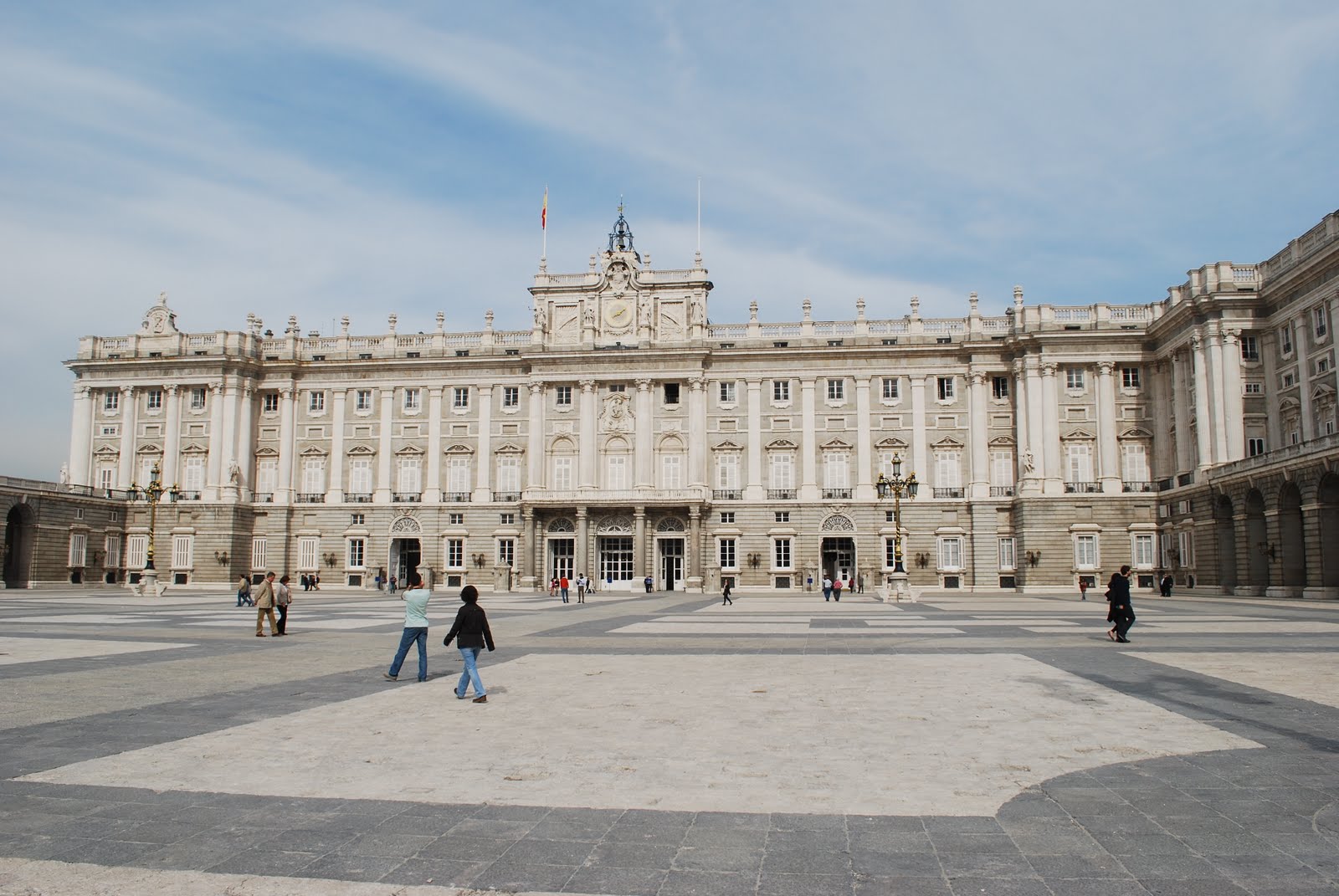
After the Egyptian Temple we entered the massive halls built as a temple to human pride, vanity, and obscene wealth and power as we walked through the second floor of the Royal Palace (Palacio Real). The third largest palace in Europe, after Versailles and Vienna's Schonbrunn, the similarities to Versailles are everywhere evident. That should not be surprising since the palace was commissioned in the 18th century by King Philip V. Though he ruled Spain for 40 years, he was very French. (The grandson of Louis XIV, he was born in Versailles and preferred speaking French.) His wife was originally from Italy and her influence is very evident as well, especially in many of the interior frescoes, ceilings, and other decorative flourishes. The palace is huge, with more than 2,000 rooms and though you only tour 24 in the public tour that is more than enough opulence and over-the-top wealth to convey the majesty and power of the Spanish royalty.

While the current King & Queen do not reside in the Palace, living in a mansion a few miles away, this place still functions as a royal palace, and is used for formal state receptions, royal weddings and funerals, and special state occasions (such as when Spain officially joined the European Union the signing ceremony took place in the Hall of Columns.) We walked on the Grand Stair up which all guests walk when arriving for state functions. We cannot remember, but I am sure we trod the same steps some of our Presidents have walked, possible President Bush and First Lady Laura, or President Clinton and First Lady Hilary. Again, it was a day for realizing connections with many, many people are much closer than we usually realize as we live day to day.

Thursday, October 21, 2010

A day for exercising the body & the spirit


A walled city where none of the streets are level, they either go up or down, not too steep, but definitely make walking interesting, especially since they are also cobblestone and extremely narrow. God forbid you meet a car coming or going. I actually had the zipper on my jacket clipped by the passenger-side mirror of a fairly quickly moving vehicle as I tried to edge around a corner that interrupted what little sidewalk was present, thus forcing you into the street. Too close a call for me!

Welcome to Toledo! It is a city with 2,500 years of history and somewhat frozen in time about 700 years ago. In fact the city is so well preserved it has been declared a national monument. The ENTIRE CITY! And the Spanish government has forbidden any modern exteriors. (Of course like any government, I guess they are exempt for the new entry they added to the Alcazar when they renovated it into a national military museum is extremely modern. It totally clashes with the rest of the building and the entire city!)

We spent a marvelous day wandering the streets of Toledo (which is exactly what you do. Even with the Guide Maps it is nearly impossible NOT to get lost. At some point it seems every tourist does so, some multiple times, or they just give in and wander and take what the city provides, which is actually a treasure around every bend or corner in the maze of streets.) For a city whose life-blood is tourism, the signage to assist visitors in getting around is extremely poor. You will start down one direction because a sign designates that way to the Mezquita, for example, and then you never see another sign the rest of the walk. Yet along the way there are multiple forks in the road and you enter numerous small plazas with numerous entrances and exits. I have had a far easier time navigating the lakes and streams of the Boundary Waters Canoe Wilderness Area in northern Minnesota than I did navigating Toledo.

Perhaps it is actually designed as a tremendous spiritual exercise?! After all, it is a walled city. Three sides are bounded by the Tajo River. It is set on top of a hill. So you really cannot get "lost" but will always bump into an edge with an option to head back toward the center. It becomes a problem if you are a goal-oriented, accomplishment-driven American who feels you must see "all" of the sights, or at least a major portion of them. So this spiritual exercise of the streets of Toledo will either drive you mad, or it will begin to break through your "expectations" of what must be achieved and experienced and begin to lead you to slow down, grow patient, go with the flow and simply experience what the city, what life, has to open up before you and, if you slow down enough to look for it, surprise you with.

We did see some of the sights: the Cathedral (huge, immense, awe-inspiring, although after a little while inside, it actually began to feel "oppressive" for Dianne), the Synagogue which houses the National Jewish Museum, a second synagogue which was once a mosque, a Christian church, and for a while served as the stables for Napoleon's horses, and the Mezquita, a very ancient ruined mosque which also was once a Christian church and has some remaining Christian frescoes on the ceiling and the walls.

But we also enjoyed a delicious and slow-paced lunch at a little restaurant where the inside was packed with locals and the outside tables filled with tourists from Germany, Italy, USA, and several other places. We ordered the Menu de Dia (a three course meal). We each had the traditional Catalan Soup; Dianne had a veal steak that looked exactly like a Palomilla and I had venison stew (Toledo is known for its wild game options for dining). It was all washed down with a cheap bottle of Red Table Wine and topped off with flan. It was good and the afternoon sun warm and enjoyable and a nice respite in the middle of the day.

We also enjoyed a surprising invitation immediately after arriving and walking up the hill to the Cathedral, by a very friendly man who told us all about a little shop of artisans just 2 minutes away where we could watch them working, for free! We decided to accept his invitation, since it was only open until noon and it was already 10:30 a.m. He walked us down the hill about two blocks to a charming little shop in a back-alley where we were introduced to two gentlemen working on gold damascene jewelry. We then entered their shop and of course purchased some very nice quality craft work from craftsmen who have been plying their trade for 25, 30, and 48 years! It was a pleasant surprise!

Toledo was a good experience at just the right time. It invited us to slow down and soak in the location, rather than keep driving to achieve all the notches we could count on our traveler's staff. After today I feel we are beginning to find that balance we wanted to achieve between sight-seeing and simply living in and soaking up the surrounding culture and environment which is Spain.

Wednesday, October 20, 2010

Amazing Art & Food in Madrid


El Prado is a museum to rival the Louvre, the Uffizi in Florence, the Art Institute in Chicago and the New York Metropolitan Museum of Fine Art. We spent six hours tracing the evolving career of Goya, from a hired artist for the Royal Court, to an artist who made political statements, to a disturbed man painting his darkest nightmares after living through the horror of the War for Independence from Napoleon, and then viewing the works of Vasquez, El Greco, Ribera, Titian, Fra Angelico, Raphael, & others. Dianne "discovered" a Mona Lisa anonymous knock-off that looked every bit as good as the more famous portrait. It is clearly the same model in the same pose without the landscape background and from the same time period as Da Vinci's painting. There were surprises around ever corner.

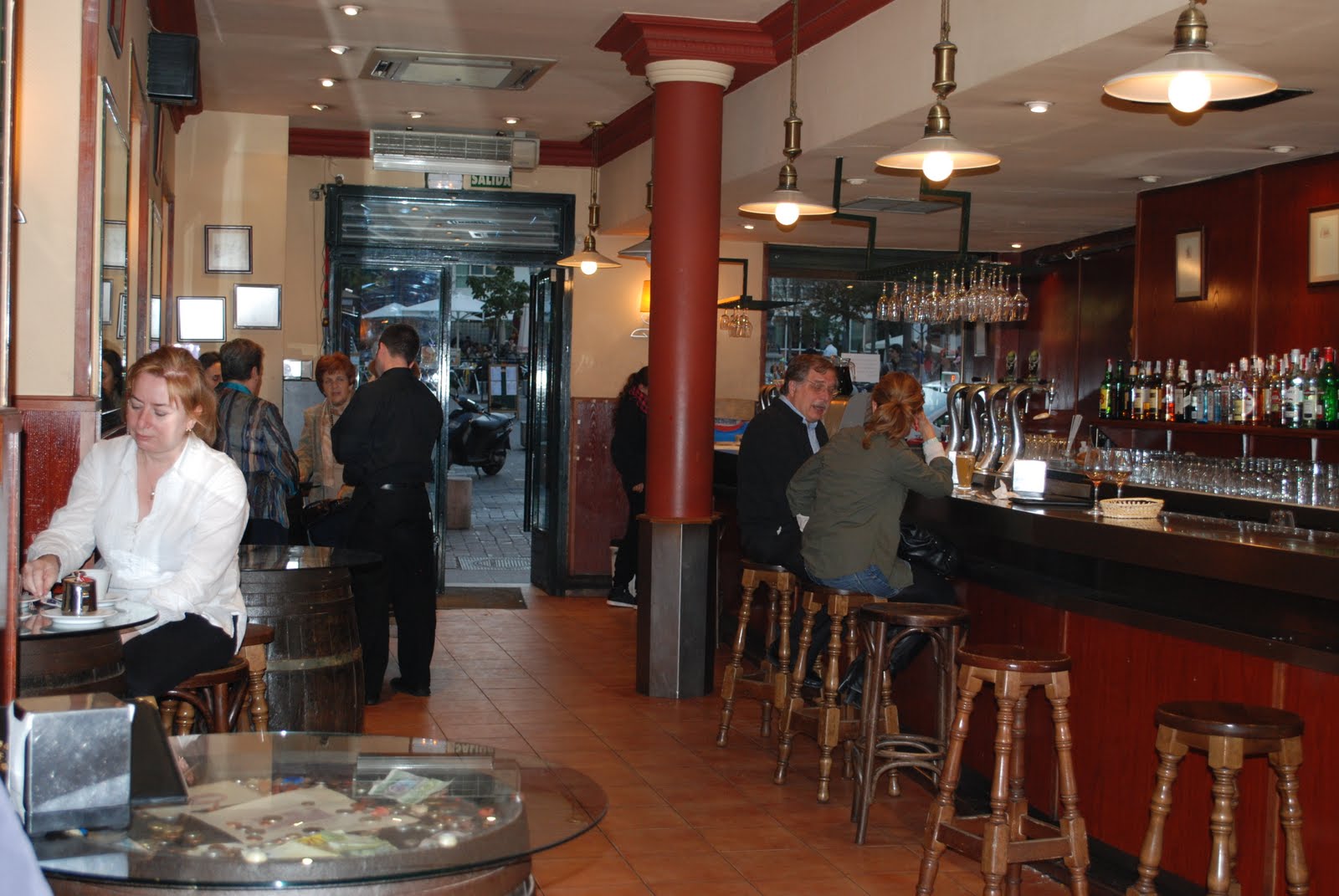
But, as amazing as the art museum was, what I really want to share with you today is about the food of Madrid. We embarked on our first "Tapas Crawl" this past evening. This is a Madrileno custom where friends travel from one pub/restaurant to another, drinking wine/beer and eating tapas (basically a Spanish appetizer). At each stop they usually get a plate or assortment to share, or just small individual servings called "pinchos." Anyway, if you are a Madrileno (that is a native to the town) and know where you are going without needing to scope the establishments out and try to size them up, and you are with a group of friends, it sounds as if it could be a fun evening. But as a couple of tourists unsure of the language, the food, and the pubs/restaurants it was actually a somewhat daunting endeavor.

The first place we stopped was a vinoteca (a wine bar) where we had a delicious Rueda Verdejo (a white wine). But, though they had a tapas menu on the table, the waiter did not return to take our order. We did not see anyone else eating in the place, so we assumed perhaps the kitchen was closed (they were advertising on the door for "help") but when we went to leave I asked the waiter if there were "no tapas" tonight and he look rather flustered as though he had missed a sale. We then checked out several more places, all of which either seemed over-priced or what I could understand of what was offered I wasn't sure I wanted to eat. We finally got off the beaten path and discovered a wonderful little neighborhood place: La Tia Cebolla Taberna (Auntie Onion's Tavern). While it appeared rather rough around the edges we dove in. The wait staff was very helpful and we enjoyed a free offering with our vino rioja (red wine) of fruti del mar (a seafood salad, which included octopus slices). This beginning was good, so we proceeded to order and then enjoyed a lovely salmon & brie on toast and the house specialty a Don Paco, which was a hot open faced sandwich of toast, tomato slices, ham, covered with melted manchego cheese, flavored with pimiento powder & basil flakes. Both were very healthy servings and were wonderful. They filled us up so our crawl basically ended there (I don't imagine a true Madrileno would end the evening after just two stops!) except for the cafe we stopped for a hotel/bar near our own hotel. I am not sure we are fans of the Tapas Crawl, but we have experienced it!

The Spanish diet is heavy on meat (much like Argentina) except that this time it is weighted toward pork rather than beef. That is very clear when you visit the Museo de Jamon (yes, that is the Museum of Ham!) This deli/restaurant is a Temple to Ham, with large leg portions of pigs hanging from the rafters and almost everything on the menu incorporating some type of pig: ham plates, ham sandwiches, chorizo sausage, etc. This is mostly a dried, salted, type of ham which is much closer to prosciutto than to our ham steaks or spiral cut hams in the US.

Overall, we have found the food very good. We had a most exquisite gourmet dinner our first evening here. We started with mushroom croquettes, followed by two cuts of veal which were wonderfully prepared, and ended with a cheesecake dessert which was basically a form of upside-down cheesecake in a bowl topped with a delicious cream and berries, along with cafe espresso para mi y cappuccino para Dianne. The owner, waiter, and chef were all very young and most attentive. It was a wonderful introduction to Spanish cooking. I fear we will not lose any weight on this vacation!