Showing posts with label Cordoba. Show all posts

Wednesday, October 27, 2010

The Wonder of La Mezquita


If ever a place on earth can truly convey the concept of infinity, La Mezquita in Cordoba, Spain comes closest. This huge mosque was the jewel of Western Islam from the late 700's when it's construction was begun by the Caliph Abd Al-Rahman when he assumed rule over Moorish Spain in Cordoba until 1236 when the Christian King Ferdinand III conquered Cordoba and reclaimed the city for Christian Spain. It is truly an amazing building and beyond inspiring! Even with the changes to it brought by the Catholic Christians (closing off many of the entrances, especially those that led in from the Courtyard of Orange Trees, by the construction of private family chapels by those wishing to be buried within the walls of what became a Christian house of worship, along with the building of a giant cathedral right in the middle of the mosque) it is still a wonder to behold. There is nothing else I have ever experienced which has conveyed such a sense of wonder and mystery.

With its sea of columns in muted shades of rose and blue, a ceiling that is only 30 feet high, yet broken up by double arches of red brick and white stone so that it feels even lower, and simple floors of stone or brick it conveys a sense of the embracing, sheltering presence of God. It is the complete opposite of everything a cathedral attempts to communicate. Cathedrals stretch upward, striving to reach heaven, extending the gaze upward toward a distant God. Cathedrals want to remind us of the majesty, wonder, awesome might, grandeur, and power of a God who is both Creator and Sovereign, Ruler and Judge over the Universe.

That is not the sort of place where I worship at home. It is not the type of place which draws me closer to God and evokes within me a sense of God's presence and love. I can be moved by the awe-inspiring works of God in the world - Yosemite Valley, the Grand Canyon, mountains rising to the skies, plains and oceans stretching to the horizon - but it is in the quite times in my own closet, the serene times in a forest glade or by a mountain stream, in the small chapels and simple churches where I am most aware that God is with me. It is in these close, intimate, womb-like spaces where I receive the assurance again that I am beloved by God, that I am not alone in this huge, often cold and impersonal world, but God is watching over me, protecting me, and embracing me in love.

La Mezquita in Cordoba embodies that for me.

Tuesday, September 30, 2008

The Jesuits in Argentina


As I am waiting for Dianne, I thought I would share some additional pictures from Córdoba (I know that seems a long time ago that I was in that city, but it was only 4 weeks.) The pictures above and in the Kodak Gallery Album link below, were taken during my tour of the Historic Museum National University of Córdoba, also known as "The Jesuit Block." This block was the center of Jesuit activity, not just in Córdoba, but really all of Argentina, beginning in 1599. At that time Córdoba was still a small town and it was the Jesuits who put it on the map. In Córdoba the Jesuits built the "Colegio Máximo" which became the National University of Córdoba, and the Colegio Nacional de Montserrat. In the surrounding regions they built "Estancias," a system of ranches to provide the support they needed for their religious and educational work.

Their work was interrupted in 1767 when they were expelled from Spain by King Carlos III, and as a result, expelled from the Spanish colonies as well. The King was bothered by their growing wealth and power. As a result, the university and the college became Federal State institutions and remain so to this day. However, much of the original buildings are still in use and a large portion of the original Jesuit Library collection is still intact, with books dating to 1515 included in the collection. This lead the United Nations to declare the colonial buildings of the Jesuit Block a World Heritage site in the year 2000. The University is the oldest university in Argentina and the fourth oldest in America. It is still considered one of the most prestigious academic institutions of Latin America.

We were not allowed to take pictures inside the Museum, where I saw the rare books collection and the Hall of Graduation, with the description of the examination process for doctoral candidates. (It was quite grueling. Went on for three full days, conducted totally in Latin, with the candidate being grilled by ALL the current doctors on the faculty.) But I was able to take pictures of the descriptive plaques which will provide you with more details on the history if you are interested. All these pictures you may find in this Kodak Gallery Album link: http://www.kodakgallery.com/I.jsp?c=6d2p4u6.ci7nk862&x=0&y=-waporw&localeid=en_US

I am including a second link to another Kodak Gallery Album which contains pictures of the Jesuit Crypt, built in the early 1700s to be a crypt and crematorium. Archaeologists do not believe it was ever used, though, as the Jesuits were evicted in 1767. The structure was buried around 1829 and forgotten until Telecom was laying underground telephone cable in 1989 and discovered it. As a result the city restored it. The link is: http://www.kodakgallery.com/I.jsp?c=6d2p4u6.76ymobu2&x=0&y=rdw377&localeid=en_US

Friday, September 12, 2008

My last day of language classes!!!


Today I accomplished one goal of my sabbatical! I completed my six weeks of Spanish language classes. Yo apprendi mucho y yo comprendo mas espanol que antes mi clases. Es necesito yo practicare mi espanol cada dia, para que mi mejorar. (I have learned much and I comprehend more Spanish than before my classes. It is necessary I practice my Spanish each day, so that I improve.) I plan to do that especially these next two weeks while I await Dianne's arrival in Buenos Aires. I return there tomorrow (actually, I get on the bus at 2 p.m. and arrive in Buenos Aires at 9:30 a.m. Sunday). I have rented an apartment for a month and will spend two weeks alone as a Porteno, practicing my Spanish, enjoying the city, and just spending time reflecting and being. It will nice to have absolutely no requirements on me or my time, not even the simple one of class. I do need to practice my Spanish, continue my exercises, but that is not a have-to, that is a desire on my part. I do want to explore more of the city, but again, it is not a have-to, but a desire on my part. I did some of that my first three weeks, and I will do more when Dianne arrives, but these two weeks, pure and simple freedom for me!

I celebrated the end of my classes. Not that I am happy they are over. In fact, there is a sadness in me. Especially at the completion of these final two weeks. I strongly connected with my last teacher, Ani Kantar. I am not sure why, but she was an excellent teacher. Perhaps, it was because my skills had improved to the point where we spent much more time conversing and I got to share more and learned more about her than I did with the other teachers. I appreciate all my teachers, for each one helped me and gave me good instruction, but Ani and Ale (my second teacher in Buenos Aires) were special and hold a special place in my heart. I will always be grateful for the skill they helped me gain in learning to communicate in Spanish.

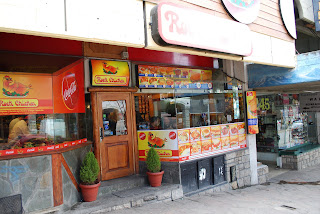
So, my celebration included: a bife y chorizo plato at Rock Chicken (the Argentine "fast food" place I pictured in the last post on food.) This was a beefsteak and pork sausage with a lettuce, onion and carrot salad and a glass of red wine (house). Then I had a celebratory drink at the Pilgrim Bar (again, pictured in the last post, through the Kodak Gallery link of pictures of Bariloche town.) I taught the bartender how to make a Rusty Nail! They had the ingredients, but had never heard of it. I taught him my recipe, which is stronger than most bars in the States, so any future requests will get a very strong Rusty Nail. It is very interesting here, when you want ice with a drink, most places provide you the ice in a mini-ice bucket! Very cute! And you add what you want. That is the explanation for the picture above! After the drink I walked across the street to the best helado joint (ice cream) in town (according to the guide books), Jauja. Since there are strong Italian influences in Argentina, most of the ice cream is like gelato, and this place is definitely that way. I had Chocolate Profundo and Praline. Excellente!! I have topped all that off with a cafe grande at Tante Frida's while I work on my computer. All their coffee, unless it is specifically labeled "Cafe Americano" is like espresso, even more than cafe cubano, and it excellent! Even a large size, is just more of the same! I love that caffeine!!!

Anyway, I am in a great mood having reached a conclusion and feeling like I have truly achieved something. Bariloche has been a great stop on my adventure. Each stop has been wonderful. Buenos Aires was a great beginning. Cordoba was wonderful for helping me learn the history. And Bariloche is gorgeous, very peaceful and tranquil, and was truly the cherry on top of the marvelous treat that has been Argentina.

I would really like to come back and spend more time in Bariloche. Of course, I would want to come back to my 6th floor apartment looking out on the lake!!! But where ever I stayed, this place would be a wonderful place to spend some time in the summer, trekking in the mountains, visiting the glaciers on Mt. Tronodor, enjoying the Lake. In fact, I would love to return and spend more time in Argentina, period. Those of you who have read from the beginning may remember my first impressions of Buenos Aries and Argentina were not positive. But I can truly say that after six weeks of living here, in three different locations, with four different families, I have come to love this country and the people. Learning the language has definitely helped, but also, spending a healthy amount of time, six weeks, has been important. You cannot truly get to know a place intimately in a two week vacation. It takes time. It takes the experience of living in a place long enough to begin to feel like a resident, to truly gain an appreciation for a location and its people. Unfortunately, most of us do not have the luxury of that sort of time when we are able to travel and visit a place. I am very thankful for the gift of this sort of time through this Sabbatical.

Thursday, September 11, 2008

More on Food


I have not been doing many tourist-like activities this week. Since I have moved downtown and on Wednesday we moved my classes into town, I have not been walking as far or visiting as many tourist locations. I did visit the Museum of Patagonia yesterday, which was very interesting. Sadly, the story of the Spanish encounters with and dealings with the Indians is the same as that of the US government. Once the railroads and refrigeration came, they could expand the cattle ranches in the pampas and so they needed to move the Indians out of the way. So they did. With violence. The pictures of the Indians in the museum from the late 1800's looked just like the pictures of the Indians in the US West from the same time period. Same faces, same clothes, basically the same people. I also visited the Cathedral, which I will say more about in another post.

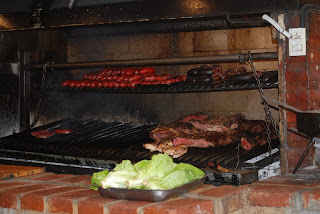
So, I want to share more about the food. I did not tell you about parrillas and asado and postres. Parrillas and asado are the pride and joy of Argentina. Parrillas are "grills" and asado is "barbecue." They are often used interchangeably, although there are differences. Asado is often roasted meat cooked over an open wood fire on a spit, in fact lambs are cooked in a splayed-out fashion that is quite dramatic. Parilla is a form of grilling meat, similar to our grills, but always with wood or charcoal, never gas (as far as I can tell.) So, in essence they are the same thing, although Argentines will argue with you if you say that.

Parrilladas are basically steak houses, and also the term for a dish of grilled meat. At parilladas you can get steaks, although the cuts all seem to be different from the way we cut steak in the US. There are lomos, vacios, asados, bife de chorizo. (Lomo = loin; vacio is a sort of strip steak, asado a cut from the end of the ribs; and bife de chorizo, a large steak.) There are also other cuts, especially in the fancier restaurants. A parillada dish of grilled meat though usually includes more than just steak. It usually includes a variety of pieces of the cow or lamb, including: chinchulinos, a piece of roasted intestine; tripe, also intestine; higado, liver; corazon, heart; mollejas, sweetbreads (usually brains); and chorizo, which is similar to Italian sausage, and blood sausage, which does seem to be sausage that has actual blood in the casing along with other stuffing (it is very moist, even after cooking, and is very dark.) This is the national dish. I did have parrillada one day in Cordoba, and it was OK. I did not gag or get nauseous. The parts were all edible, but honestly, not my cup of tea. I would prefer a nice, juicy steak rather than all the innards, but I can say I tried it. I don't plan to try it again, unless Dianne wants to, and then I will since, actually, it is usually served as a dish for two or more people. (In Cordoba the owner of the Parilla was nice enough to split one for me.) The steaks are delicious. The beef is supposedly all grass fed on pampas grass, not in feed lots and not pumped full of chemicals. They pride themselves on the natural state of their beef. I have yet to encounter a tough or stringy steak.

As I mentioned, they do a lot with pasta, as well as chicken (almost everything they do with steak they do with chicken, and they also do more traditional chicken dishes) and they have pizzas galore. They have lots of wine available, the reds are the best, and in many places you can get cheap house wine by the glass or jar, which is not bad, and of course wherever you are ordering meat you can get bottles of wine, in a wide range of prices. They also serve water with or without gas and gaseosas (which are sodas).

For desserts they do flan, and rice pudding, plus tiramisu, and tortas (which are cakes, in a wide variety of styles, all very large portions and very rich looking.) They also have helado (ice-cream) which, because of the influence of their Italian immigrants, is basically the same as gelato! And, in Bariloche, they do chocolate! Wow, do they do chocolate. You cannot walk down a block on any street in the downtown without encountering a chocolate store. Some of the larger stores have two or three locations (smaller satellite locations in addition to the main store). I taste tested my way through many of the stores searching for the best to buy for family back home and definitely Mamuschka is THE BEST! They have bonbons filled with liquor that is like getting an actual shot of whisky once you bite into it! Not just a taste. And their tablets of dark chocolate are divine. The second-best I found is a small shop on the other main street, "Chocolate de Pueblo" and the third best was a small shop where you could see them making the chocolate out my the school, but I have not returned there, so I only tried it once. There is even a chocolate museum in town, operated by Fenoglio, one of the large chocolate stores, but I did not visit. I have definitely been following the new physician guidelines for preventing strokes by consuming a small (I stress small) quantity of dark chocolate each day while I am here. (I have also lost weight, so I promise you it has been a small quantity. Besides, the chocolate is so rich that you really do not need, nor can I, consume a large amount.)

I am including a link to a Kodak Gallery album with pictures of Bariloche town that give you a feel for the city itself, aside from the spectacular views of the mountains and lake. The pictures above are of two parillas, the one in Bariloche of which I spoke, and the small one in Buenos Aires, with examples of the meat on the grill. Follow this link to the pictures of Bariloche: http://www.kodakgallery.com/I.jsp?c=6d2p4u6.2m4f8m3a&x=0&y=8z6e2g&localeid=en_US

Wednesday, September 3, 2008

The Churches in Cordoba


While in Cordoba I visited many churches. It is a city filled with history. Cordoba is one of the oldest cities in Argentina, founded by the Spanish extending the reach of their territory from Peru, in 1573. With the arrival of the Jesuit missionaries 23 years later in 1596, Cordoba quickly became an important educational center in the new Spanish territory and colonies in South America. I will say more about this and the Universidad Nacional de Cordoba in a future post. Now I want to share with you about the churches.

The oldest church in town, at least in terms of the beginning of its construction, is the Iglesia Catedral, the Cathedral. Construction began in 1577, but dragged on for over two centuries under several architects, including Jesuits and Franciscans. As a result it lacks architectural unity, but it is still a beautiful structure. Crowned by a Romanesque dome, it overlooks Plaza San Martin, the main Plaza de Armas of the city. Its lavish interior was painted by renowned cordobes (Cordoban) painter Emilio Caraffa. As in many Catholic Churches, I found the interior very gaudy, overly decorated, and filled with all sorts of statuary, dioramas, and other religious art work.

The second oldest church in town is the Iglesia de la Compania de Jesus. Its construction began in 1645 but was not completed until 1671. It was designed by the Flemish Padre Philippe Lemaire, who was once a boat builder. This fact is important because it helps explain the most interesting ceiling construction of the church, which is designed like an inverted hull of a ship. There are not apparent supports, other than the walls, and to achieve this effect, Lemaire constructed the entire ceiling out of Paraquayan cedar, a very light wood, from Misiones province, in northeast Argentina. The entire design is new world baroque, and the baroque altarpiece is also constructed from Paraquayan cedar, which is overlayed in gold. It is also interesting that the structure was built in segments in Misiones province, to exact dimensions taken by Lemaire, and then transported to Cordoba to be assembled in the Church.

The other extremely interesting church I visited was the Parroquia Sagrado Corazon de Jesus de los Capuchinos. This was probably the most fascinating of the Churches. It is built in the neo-gothic style and was constructed between 1928 and 1934. Its glaring oddity is a missing steeple (omitted on purpose to symbolize human imperfection.) It is gorgeous inside and out. Outside the facade is covered with statues, beginning with the lowest statues a series of Atlases symbolically straining to bear the spiritual weight of the religious figures above them, which include the 12 apostles, Jesus, numerous female characters, or angels, etc. Be sure to check out the pictures in the Kodak Gallery link.

Cordoba will go down, probably, as my most religious week in Argentina. I began the week by attending worship in a local Evangelical Church. I learned that they worship primarily in the evening, probably because Argentinos stay up late, sleep late, and are more geared to night-time activities, but my hostess really didn't know the reason. I visited six Catholic churches, two of them twice, and three of them on Sunday when mass was being held (I did not stay for any of the masses, but I did look in and noticed that they were fairly well attended.) My impression is that contrary to what I have been told by many of the local people, the religious life, even the life of the churches, is alive and well, even vibrant. Undoubtedly it could be stronger, but then again, the religious life in the United States could be stronger as well.

If you are interested in viewing more pictures of these churches, follow these links to the Kodak Gallery albums I have created. You do not have to join anything to view the albums, just click the "view album" option. If you want to save the photos to your own account, then you have to open an account, which is free.


This link goes to pictures of the Church of the Jesuits: http://www.kodakgallery.com/I.jsp?c=6d2p4u6.9o8kje16&x=0&y=clvf24&localeid=en_US

Saturday, August 30, 2008

Where I lived and studied in Cordoba


This is my last post for at least 24-36 hours. This afternoon I board the bus for San Carlos de Bariloche, a small resort town in the Andes mountains on Lake Nahuel Huapi. It is supposed to be beautiful, even the two men who run the local mini-grocery market where I have been buy fruit responded last night to my statement that it was the last time I would see them because I was going to Bariloche the next day with "Que linda" & "muy bonita!" (How beautiful!) I wanted to give you one more quick post about where I have been studying and living and with whom in Cordoba. I will have to add the Kodak link to more pictures of my home interior later when I have better computer access, but for now here are the pictures of my teacher, my home-stay family, and the locations.
The first picture shows my hostess, Señora Maria del Carmen Linzitto (Luli to those who know her and love her [which includes the 110 foreign students she has hosted in her home in the past 10 years, along with countless Argentine students as well]), with Fanny Lopez, a young woman living here while she works to raise money to pay for her to become a missionary to Mozambique, and Shigeharo Fujimoto, a Japanese student studying Spanish at the University of Cordoba. The second picture is Luli's home, entered through the left hand door of the two shown, to go upstairs to the apartment. My bedroom is the upstairs window at the far right.
The third picture is of me with my teacher in Cordoba, Señora Olga Yanovich de Parmigiani. Finally, there is a picture of the building which held the school, on the seventh floor, yes the top floor, but there was a lift, thank goodness. Now that I am leaving, these are the people and places I spent much of my time with, although as you have already read, I did see a lot and spent every afternoon out and about. I will try to post pictures of the people and places I live and study in Bariloche earlier in my stay there. Until I post from Bariloche, Adios y ciao!

Friday, August 29, 2008

The end of a good week in Cordoba


I am about to wrap up my week in Cordoba. It was a very good decision to come here. The weather has been very warm, in the 70s almost every day. I have only worn my jacket really in the morning, some in the late afternoon/early evening. It was a true immersion experience, with no one around me speaking English and having limited contact with home. I did finally find the CNN in English channel in time to watch Barack Obama's acceptance speech. I definitely feel as though I have been learning Spanish on a fast track this week. Also, this place is filled to overflowing with history. I also feel like I have been on a crash course in the history of the Jesuits, of Cordoba, of Argentina, of all South America. I have visited churches, and museums, until I am filled to overflowing with information. I am actually looking forward to my 21 hour bus ride to Bariloche. Basically moving from here to there will take me the better part of two days and the down time for my brain to process what I have absorbed this week will be wonderful. I am also looking forward to the scenery, although everyone I talk to around here says it will be "boring" (or as they say "burrado".) But it will all be new to me.

I got a taste of the landscape today by going on a mini-bus to Alta Gracia, a small town about 50 kilometers south-west of Cordoba. It is in the foothills of the Sierra mountains, so I saw flat, flat, flat (like west-Texas flat) terrain and then low mountains. It is a nice little town that grew up around an Estancia (one of the ranches the Jesuits founded to support their mission work). It also is the place Che Guevara´s parents brought him as a young boy looking for a better climate for his asthma. He basically grew up here, living here and in Cordoba until he went off to Medical School in Buenos Aires. The museum was quite interesting, and I took lots of pictures for my son Paul, but it is one-sided. It acknowledges his revolutionary activity, but without any detail about his participation in executions, etc. in Cuba which has made him so hated by the Cuban people. Still, it was a very interesting place.

I won't say much more about Cordoba or Alta Gracia, as I cannot still add many pictures. I hope my computer situation improves in Bariloche. I will add one more post either later tonight or tomorrow morning with some photos of my hostess and my home and school here in Cordoba. I will then bring you more updates and, hopefully, more pictures of Cordoba next week from Bariloche. I have the feeling that I will not be as busy in Bariloche, as it is primarily an outdoor resort type town and the weather is supposed to be cold (in the 30s & 40s) with rain, which suggests that I may be spending a good bit of time inside. If so, assuming my computer can connect to WI-FI than I will be able to catch you up on this past week and a little bit remaining from Buenos Aires.
The pictures above are of the Sierra mountains from Alta Gracia; me in front of the Che Guevara Home Museum (kindly taken by a young woman from Costa Rica); a fountain in Cordoba; and the oldest church in Cordoba lit up at night. If you want to see more pictures, follow these links to the Kodak Gallery Albums I have created. This first link takes you to more photos of the Che Guevara Home museum: http://www.kodakgallery.com/I.jsp?c=6d2p4u6.cfz0t4kq&x=0&y=-dshwcs&localeid=en_US
This second link takes you to more photos of the Estancia: http://www.kodakgallery.com/I.jsp?c=6d2p4u6.3qrnum4q&x=0&y=l52cwz&localeid=en_US

Wednesday, August 27, 2008

Church Worship in Cordoba

One of the first things I did upon arrival in Cordoba was attend a service of worship on Sunday evening. It was at the church which my hostess attends. She was so excited when she learned a pastor was staying in her home. She also has a young woman studying and preparing to become a missionary from this church to Mozambique, once she learned English, French, and raises the funds for her mission. Anyway, it was an excellent opportunity to experience worship in Argentina since I would have someone to go with and would not have to walk in alone, as a total stranger. As it turned out Luli, my hostess, had to visit a friend in the hospital and did not make it to church (which started at 5:30 p.m., the first service for Sunday, the second started at 8:00 p.m.) but Fanny, the young woman preparing for a mission and the Japanese student studying Spanish at the University and staying here, accompanied me to their church.

The Church is called Iglesia de Centro Christian and was founded 16 years ago by an Assembly of God missionary from the United States. Since that time this church, which is not huge (but did appear to have more attendance than Christ Congregational) has sent out 40 missionaries into the world. This night had a mission focus. It was led by their Director of Missions and the preacher was a guest missionary who is Argentinian but has a mission to Italy. He shared photos on his experience the past 8 years and he preached a message which I think (it was all in Spanish) was on the gospel story of the young man challenged by Jesus to give up all and follow him. The message seemed to be about the difficulty of following Jesus, especially in mission work, but that the ultimate reward was worth it. Again, I am not sure of the finer points.

The worship was very much like Assembly of God worship in the US. They had a Praise Team that led a lot of singing, several songs I recognized, though of course they were in Spanish. There were several pauses for prayer, for personal testimonies, and for special mission appeals. The entire worship lasted 2 hours and I was tired after, primarily because it was very hard work to follow in Spanish and try to stay focused. Again, I have a deeper appreciation for those who have limited English capacity and try to follow our worship, even for only one hour. If you want to see some pictures of the worship leadership team, follow this link to the Kodak Gallery album I have created: http://www.kodakgallery.com/I.jsp?c=6d2p4u6.29ljy8sa&x=0&y=-dmmvjb&localeid=en_US

Monday, August 25, 2008

The places I stayed and worked


Now that I am in Cordoba, I want to try to catch you up on some things from Buenos Aires. Tomorrow or the next day I will share with you more of my impressions of Cordoba. The pictures I have posted are of the places I lived and worked in Buenos Aires. As you can tell, they are not real exciting, but they do, at the end of my time in those places (lo siento, sorry) let you know where I went home to every night, where I went to learn Espanol (although I have been corrected by my hostess and her amiga in Cordoba that I am learning Castellano, not Espanol, lo siento, again. They seem very big on their historical connection with Castelon, or is it Castillo, in Spain, from which the language originated here in Cordoba. This was the original location of education, culture, and the monied elite in Argentina long before Buenos Aires became a center of government and the country.) But I digress to Cordoba, let me get back to the past three weeks in Buenos Aires. The first picture is of Senora Vivi Restelli, my hostess for my three weeks in Buenos Aires at the language school. The apartment of Senora Restelli is in the second photo. It was on a busy avenue, Avenida Cordoba about 10 blocks from the school, on another busy street Calle Callao, just around the corner from one of the primary avenues, Avenida Corrientes, which in this area is the heart of the theater district. (It is the Buenos Aires equivalent to Broadway.) Her apartment is the balcony immediately above the door to the street. (I posted pictures of the inside of her apartment in an earlier post the beginning of August. ) [So you get a true feel for my life here, I do not have Internet access for my laptop, no WI-FI in the home where I am staying, so I am writing this while sitting outside at a cafe where I have internet access, but no power access, and so I am doing this while eating. I am enjoying a marvelous steak Milanese Neapolitan with mashed calbasas squash and I just got my sleeve in the squash while typing! Such is the life of a traveling pastor on sabbatical! By the way, you did catch that I am sitting outside. It is a glorious 70+ degrees out today. Feels like Miami!!!]

Anyway this post has become far longer than I intended. There is also a picture of the building the school is in (at least the one I attended, it is supposed to move to a new location the first of September). The school is located behind the third set of windows above the Libreria Santa Fe. Finally, there is a picture of the building which houses the dance studio where I took Tango lessons, again, not real exciting, but it is located on the fourth floor up from the ground. It turned out to be a wonderful stay and experience, my first three weeks in Buenos Aires. Senora Restelli is a fascinating woman who reads a lot, thinks deeply, has some off-beat ideas, but was a marvelous hostess. It was a pleasure and joy to stay with her and I got a very good idea what many, many Buenos Aires residents are like.

Sunday, August 24, 2008

The Bus Ride to Cordoba


I am sitting in a cafe/restaurant having finished lunch, using their WI-FI access to update my blog. I am also watching a local futbol match on TV with several groups of futbol fans. It is just like being in Miami during football season! Anyway, sorry for no pictures with this post. I do not have access to a power plug and my battery is low, so I want to get this post up and if you read it without pictures, check back tomorrow or later and I will add some pictures of Cordoba to this post (they have been added.) I walked around this morning getting acquainted with the town, finding out where the school was located, looking for Internet access (as I could not get on in the home I am staying). I took lots of pictures as this is a very historic town. It actually seems to have it over Buenos Aires in terms of history. Evidently Cordoba was founded and built up earlier than Buenos Aires by the Jesuits who immediately began making it an educational and cultural center. It is much smaller than Buenos Aires, only 1,300,000 people, and it has definitely preserved more of the very, very old buildings, some dating to the 1500's. Anyway, I will add pictures later. It is definitely a more laid back, calmer city and I think it will be nice, much needed break for me. (Plus it is supposed to be warmer this week. Today with the sun out it must be somewhere in the 60s pushing 70s. It is supposed to go into the 80s, maybe get close to 90 on Thursday. Checking on a map I figured out Cordoba is at a similar latitude in this hemisphere to Jacksonville, FL in the northern hemisphere. Buenos Aires is about the same latitude as Charlotte, North Carolina.)

One reason my battery is running low is I did make sure to call Dianne early this morning, sitting in an empty plaza, using my battery power and connecting to whatever unsecured system I could find. I ended up talking longer than I planned because of the news she had to share. For those who have not heard, we have a new grandchild! Kati & Ryan had their baby early Sunday morning. Reese Ella Foley arrived at 1:57 p.m. on 24 August weighing 5 pounds, 15 ounces at 19 inches long. Mother and baby are fine (I also had to call Kati and congratulate her and hear about her delivery for myself.) I do not have pictures to post, but maybe Grandma Di will send me some!

Anyway, now to the bus ride here from Buenos Aires. Quite an experience. The bus was very comfortable. They have 3 options for buses here, semi-cama, coche-cama, and luxury. The semi-cama is cheapest, but the seats only recline about like an airplane seat. The luxury seats go all the way down like a bed, but they are very expensive. The coche-cama is a very good option which a lot of people use. The seats recline about like a barca-lounger and have a pedestal for your feet that comes down from the seat in front of you. So it is just like being an a very comfortable lounge chair. Many of us in the U.S. are use to this style of sleeping (usually in front of the TV) and would find these buses very comfortable.

What was problematic about the bus first was it was about 45 minutes late in arriving. Evidently this is very unusual as all the people waiting with me were quite disturbed, as was I. But it did show, I did not miss it. Then, it made several stops on the way to Cordoba which was very disturbing to me as the stations are not well marked and you cannot tell where you are very easily. I kept asking (Esta Cordoba?). The first stop I realized was not Cordoba, but the second disturbing thing happened here. We took on quite a few passengers and several were young men, apparently drunk, and spent about an hour talking rather loudly. Now understand this is already 11 p.m. or later and most people on the bus were already trying to sleep. So, I just put on my ipod to Kenny Chesney and tried to drown them out. The final upsetting thing was that when we arrived at Cordoba I was groggy having fallen back to sleep, and I left my best travel guidebook, the most recent edition I had from Bradt, on the bus. I was slow getting off, worried about getting my luggage, had to get change to tip the young man who took my suitcase out of the luggage bay (and who was insulted with 15 centavos, even though he kept it and indicated he needed more before he would release my suitcase) and so I ended up leaving my guidebook on the bus. (At least it wasn't something more important like my passport, or wallet, or travel journal where I am recording even more thoughts and experiences than I am sharing here. Sorry, I can expose only so much of myself publicly.) Unfortunately I did not get to see much of the countryside as it was dark the entire trip, but I was awake for a while once we reached Cordoba Province and what I could see in the dark suggest that it is flat as the Texas Panhandle. There did not appear to be a mound or hill, and I could see lights way off in the distance indicating towns. I hope to take an afternoon tour outside Cordoba to an estancia and I should be able to get a look at the landscape then. This has turned into a rather long post, so I better finish for now. But, if you would like to see a few more photos of my first walk around Cordoba, follow this link to the Kodak Gallery album: http://www.kodakgallery.com/I.jsp?c=6d2p4u6.cm4dgwu2&x=0&y=6pniec&localeid=en_US